Back

Lipids 2 definitions

Control buttons has been changed to "navigation" mode.
1/14
  • Glycerophospholipid

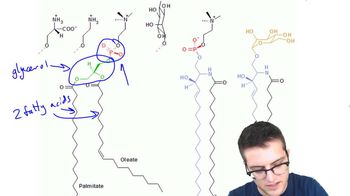
    A membrane lipid with a glycerol backbone, two fatty acids, a phosphate group, and a variable head group.
  • Sphingolipid

    A membrane lipid featuring a sphingosine backbone, one fatty acid, and often a phosphate group with a head group.
  • Phosphatidylcholine

    A glycerophospholipid with choline attached to the phosphate group, commonly found in eukaryotic membranes.
  • Phosphatidylethanolamine

    A glycerophospholipid with ethanolamine as the head group, sharing the same backbone as phosphatidylcholine.
  • Phosphatidylserine

    A membrane lipid with serine as the head group, contributing to membrane structure and signaling.
  • Phosphatidylinositol

    A membrane lipid with inositol as the head group, important for cell signaling pathways.
  • Glycerol

    A three-carbon molecule forming the backbone of glycerophospholipids, connecting fatty acids and phosphate.
  • Fatty Acid

    A hydrocarbon chain attached to lipid backbones, influencing membrane fluidity and structure.
  • Phosphate Group

    A chemical group linking the backbone to the head group in membrane lipids, crucial for polarity.
  • Choline

    A nitrogen-containing molecule serving as the head group in certain membrane lipids, such as phosphatidylcholine.
  • Ethanolamine

    A molecule attached to the phosphate group in phosphatidylethanolamine, affecting membrane properties.
  • Sphingosine

    A long-chain amino alcohol forming the backbone of sphingolipids, replacing glycerol in these lipids.
  • Sphingomyelin

    A sphingolipid with choline and phosphate as head groups, structurally similar to phosphatidylcholine.
  • Membrane Lipid

    A molecule forming biological membranes, providing structural integrity and functional diversity.