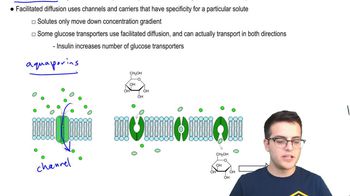
What is the primary purpose of a channel protein in membrane transport?
The primary purpose of a channel protein is to facilitate the passive movement of specific molecules or ions across the cell membrane, allowing them to move down their electrochemical gradient without the use of cellular energy. Channel proteins provide a selective, often gated, pathway for substances such as water (via aquaporins) or ions to rapidly cross the membrane.
Why is water able to cross the membrane via both simple diffusion and facilitated diffusion?
Water is small enough to pass through the membrane by simple diffusion despite being polar, but it also uses aquaporin channels for faster transport. This dual mechanism ensures efficient movement required for biological processes.
What distinguishes a channel protein from a carrier protein in terms of transport directionality?
Channel proteins typically allow movement in one direction, acting like open tubes, while carrier proteins can move substances in both directions across the membrane. However, carriers only transport solutes down their concentration gradient during facilitated diffusion.
How do cells maintain a low internal glucose concentration to favor glucose import?
Cells rapidly convert imported glucose to glucose 6-phosphate, reducing the concentration of free glucose inside the cell. This maintains a gradient that favors continued glucose entry.
What is the role of gating mechanisms in some channel proteins?
Gating mechanisms allow channels to open or close, controlling the passage of specific solutes. This selectivity ensures that only certain molecules can cross the membrane at specific times.
How does the sodium-potassium pump contribute to membrane transport?
The sodium-potassium pump uses ATP to move three sodium ions out of the cell and two potassium ions into the cell against their concentration gradients. This active transport maintains essential electrochemical gradients for cellular function.
What is the function of proton pumps in cellular respiration?
Proton pumps move hydrogen ions into the intermembrane space of mitochondria, creating an electrochemical gradient. This gradient, known as the proton motive force, drives ATP synthesis via ATP synthase.
Why is facilitated diffusion considered a passive transport process?
Facilitated diffusion does not require cellular energy and moves solutes down their electrochemical gradients. It relies on channels and carriers for specificity and efficiency.
What is the significance of the proton motive force in ATP production?
The proton motive force is the electrochemical gradient generated by proton pumps during cellular respiration. It powers ATP synthase, enabling the synthesis of ATP from ADP and inorganic phosphate.
How do aquaporins differ from other channel proteins in terms of selectivity?
Aquaporins are specialized channel proteins that selectively transport water molecules across the membrane. Unlike other channels, they exclude ions and other solutes, ensuring only water passes through.