Pearson+ LogoPearson+ Logo

Metabolic Regulation 1 quiz #1 Flashcards

Back
Metabolic Regulation 1 quiz #1
Control buttons has been changed to "navigation" mode.
1/10
  • What are the main factors that regulate the rate of metabolism in cells?

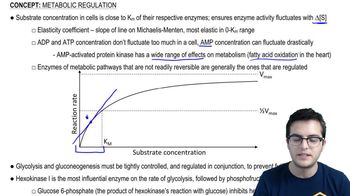
    The rate of metabolism is primarily regulated by substrate concentration (especially near the enzyme's Km), the activity of key regulatory enzymes (such as hexokinase 1 and glucokinase), and cellular energy status indicators like AMP, which is sensed by AMP-activated protein kinase. Enzymes that catalyze non-reversible reactions are tightly regulated to prevent futile cycles.
  • What is the significance of the elasticity coefficient in metabolic regulation?

    The elasticity coefficient reflects how sensitive enzyme activity is to changes in substrate concentration near the Km. This sensitivity allows cells to finely tune metabolic rates in response to small substrate fluctuations.
  • Why do cells prefer to operate with substrate concentrations near the enzyme's Km?

    Operating near the Km ensures that enzyme activity can respond dynamically to changes in substrate levels. This enables effective metabolic regulation and adaptability.
  • How does AMP concentration differ from ADP and ATP in terms of cellular fluctuation?

    AMP concentration fluctuates much more dramatically than ADP or ATP in cells. This makes AMP a more sensitive indicator of cellular energy status.
  • What role does AMP-activated protein kinase play in metabolism?

    AMP-activated protein kinase detects changes in AMP concentration and triggers widespread metabolic effects. It helps coordinate cellular responses to energy availability.
  • Why are enzymes that catalyze non-reversible reactions tightly regulated?

    Non-reversible enzymes drive metabolic pathways and can shut down entire pathways if inhibited. Tight regulation prevents energy-wasting futile cycles in metabolism.
  • What is a futile cycle in the context of glycolysis and gluconeogenesis?

    A futile cycle occurs when the product of one pathway is converted back to the substrate by another, wasting energy. Tight regulation of key enzymes prevents this from happening.
  • How does glucose 6-phosphate regulate hexokinase 1 activity?

    Glucose 6-phosphate inhibits hexokinase 1, serving as a feedback inhibitor. This prevents excessive accumulation of glucose 6-phosphate in cells.
  • Where is glucokinase (hexokinase 4) found and how is it regulated?

    Glucokinase is found only in liver cells and is stored in the nucleus until needed. Its activity is stimulated by glucose and is not inhibited by glucose 6-phosphate.
  • How does the Km of glucokinase compare to that of hexokinase 1, and what is the consequence for reaction velocity?

    Glucokinase has a much higher Km than hexokinase 1, meaning it requires higher glucose concentrations to reach maximum velocity. This allows liver cells to continue converting glucose even at high glucose 6-phosphate levels.