Back

Nucleic Acids 1 definitions

Control buttons has been changed to "navigation" mode.
1/15
  • Nucleic Acid

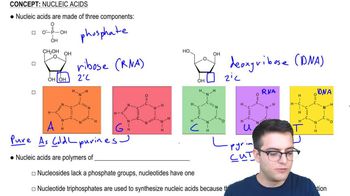
    Polymer formed from repeating nucleotide units, essential for genetic information storage and transfer in cells.
  • Nucleotide

    Molecule composed of a phosphate group, a pentose sugar, and a nitrogenous base; building block of nucleic acids.
  • Nucleoside

    Compound consisting of a pentose sugar attached to a nitrogenous base, lacking a phosphate group.
  • Phosphate Group

    Chemical moiety providing negative charge and energy for nucleic acid polymerization, attached to the sugar.
  • Ribose

    Five-carbon sugar with a hydroxyl group at the 2' position, found in RNA.
  • Deoxyribose

    Five-carbon sugar lacking a hydroxyl group at the 2' position, present in DNA.
  • Nitrogenous Base

    Organic molecule forming part of nucleotides, classified as purines or pyrimidines, encoding genetic information.
  • Purine

    Double-ring nitrogenous base type including adenine and guanine, found in both DNA and RNA.
  • Pyrimidine

    Single-ring nitrogenous base type including cytosine, thymine, and uracil, differing between DNA and RNA.
  • Adenine

    Purine base present in both DNA and RNA, pairs with thymine in DNA and uracil in RNA.
  • Guanine

    Purine base found in DNA and RNA, pairs with cytosine, contributing to genetic code stability.
  • Cytosine

    Pyrimidine base in DNA and RNA, susceptible to deamination, pairs with guanine.
  • Thymine

    Pyrimidine base exclusive to DNA, distinguished by a methyl group, pairs with adenine.
  • Uracil

    Pyrimidine base exclusive to RNA, replaces thymine, pairs with adenine.
  • Nucleotide Triphosphate

    Nucleotide with three phosphate groups (α, β, γ), supplies energy for nucleic acid synthesis.