Back

Nucleic Acids 2 definitions

Control buttons has been changed to "navigation" mode.
1/15
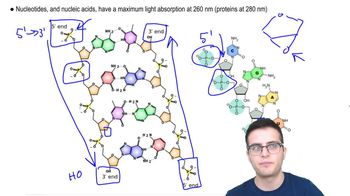
  • Nucleotide

    Monomer unit of nucleic acids, composed of a pentose sugar, phosphate group, and nitrogenous base.
  • Phosphodiester Bond

    Covalent linkage joining adjacent nucleotides via phosphate groups attached to 5′ and 3′ carbons of sugars.
  • Antiparallel

    Orientation of DNA strands running in opposite 5′ to 3′ directions, ensuring proper base pairing.
  • 5′ End

    Terminal of a nucleic acid strand marked by a phosphate group attached to the fifth carbon of the sugar.
  • 3′ End

    Terminal of a nucleic acid strand marked by a hydroxyl group attached to the third carbon of the sugar.
  • Hydroxyl Group

    Functional group present at the 3′ end of DNA and at both 2′ and 3′ carbons in RNA, affecting stability.
  • Base Pairing

    Specific hydrogen bonding between complementary nitrogenous bases, maintaining double helix structure.
  • Adenine

    Purine base in DNA and RNA, pairs with thymine in DNA and uracil in RNA via two hydrogen bonds.
  • Thymine

    Pyrimidine base in DNA, forms two hydrogen bonds with adenine, absent in RNA.
  • Guanine

    Purine base in DNA and RNA, forms three hydrogen bonds with cytosine, contributing to helix stability.
  • Cytosine

    Pyrimidine base in DNA and RNA, pairs with guanine via three hydrogen bonds, affecting melting temperature.
  • Purine

    Nitrogenous base category with a two-ring structure, includes adenine and guanine, always paired with pyrimidines.
  • Pyrimidine

    Nitrogenous base category with a single-ring structure, includes thymine and cytosine, paired with purines.
  • Double Helix

    Consistent-width structure formed by two complementary, antiparallel DNA strands held by base pairing.
  • UV Absorption

    Characteristic property of nucleic acids, with maximal absorption at 260 nm, distinguishing them from proteins.