What is the function of a helicase protein in the context of DNA structure and gene expression?
A helicase protein functions to unwind the double helix structure of DNA, separating the two strands to allow processes such as DNA replication and gene expression to occur.
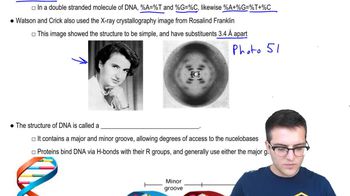
What key experimental technique did Rosalind Franklin use to help reveal the structure of DNA?
Rosalind Franklin used X-ray crystallography to produce images of DNA. Her famous Photo 51 provided crucial evidence for the double helix structure.
What is the significance of the 3.4 angstrom spacing in DNA?
The 3.4 angstrom spacing refers to the distance between adjacent bases along the DNA helix. This measurement was critical in deducing the regular, repeating structure of DNA.
What are the two types of grooves found in the DNA double helix?
The DNA double helix contains a major groove and a minor groove. These grooves are important for protein and enzyme interactions with DNA.
How do proteins typically interact with DNA during gene expression regulation?
Proteins generally bind to DNA using the major groove, although some specific proteins may use the minor groove. These interactions are essential for regulating gene expression.
Why is DNA considered a flexible molecule?
DNA is flexible because its backbone and nucleotides are primarily composed of single bonds. This flexibility allows the molecule to bend and twist as needed for biological functions.
What are the two possible conformations of DNA bases, and which is more common?
DNA bases can adopt either the syn or anti conformation. The anti conformation is much more common in natural DNA.
What does Chargaff's rule state about purines and pyrimidines in double-stranded DNA?
Chargaff's rule states that the amount of purines equals the amount of pyrimidines in double-stranded DNA. This ensures base pairing and structural stability.
Which scientists used Chargaff's rules and Photo 51 to determine the structure of DNA?
Watson and Crick used Chargaff's rules and Rosalind Franklin's Photo 51 to deduce the double helix structure of DNA. Their work was foundational in molecular biology.
What structural feature of DNA allows for the flip-flop of base orientation?
A single bond between certain positions in the nucleotide allows the base to flip between syn and anti conformations. This flexibility is part of DNA's dynamic nature.