Why do enzymes have specific optimal pH values, and how does deviation from this pH affect their activity?
Enzymes have specific optimal pH values because the charges of ionizable amino acids, especially those in the active site, are influenced by pH. Changes in pH can alter these charges, potentially hindering catalysis and disrupting protein structure, which may lead to denaturation and loss of enzyme activity.
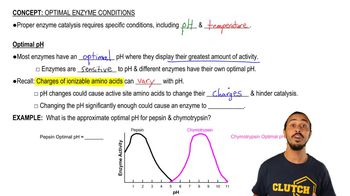
What are the approximate optimal pH values for pepsin and chymotrypsin, and how do these relate to their physiological environments?
Pepsin has an optimal pH of about 1.5, matching the acidic environment of the stomach, while chymotrypsin has an optimal pH of about 8, which suits the more basic conditions of the small intestine.
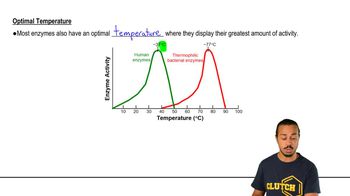
How does temperature affect enzyme activity, and what are the optimal temperatures for human enzymes versus thermophilic bacterial enzymes?
Enzyme activity increases with temperature up to an optimal point, after which activity declines due to denaturation. Human enzymes have an optimal temperature around 37°C (body temperature), while thermophilic bacterial enzymes are optimized for much higher temperatures, around 77°C, reflecting their adaptation to hot environments.
How does the evolution of enzymes reflect the environments in which organisms live?
Enzymes have evolved optimal pH and temperature conditions that match the environments of their host organisms, ensuring efficient catalysis and survival. For example, human enzymes function best at body temperature, while thermophilic bacterial enzymes are adapted to high temperatures found in hot springs.
Why do enzymes have specific optimal pH values?
Enzymes have specific optimal pH values because the charges of ionizable amino acids, especially in the active site, are influenced by pH. Changes in pH can alter these charges, potentially hindering catalysis and disrupting protein structure.
What can happen to an enzyme if the pH deviates significantly from its optimal value?
Significant deviation from optimal pH can cause the enzyme to denature, leading to loss of structure and enzyme activity.
What are the approximate optimal pH values for pepsin and chymotrypsin?
Pepsin has an optimal pH of about 1.5, while chymotrypsin has an optimal pH of about 8.
How do the optimal pH values of pepsin and chymotrypsin relate to their physiological environments?
Pepsin's optimal pH matches the acidic environment of the stomach, while chymotrypsin's optimal pH suits the more basic conditions of the small intestine.
How does temperature affect enzyme activity, and what are the optimal temperatures for human and thermophilic bacterial enzymes?
Enzyme activity increases with temperature up to an optimal point, after which it declines due to denaturation. Human enzymes are optimal at about 37°C, while thermophilic bacterial enzymes are optimal at about 77°C.
How does the evolution of enzymes reflect the environments in which organisms live?
Enzymes have evolved optimal pH and temperature conditions that match their host organisms' environments, ensuring efficient catalysis and survival. For example, human enzymes function best at body temperature, while thermophilic bacterial enzymes are adapted to high temperatures.
What is the optimal pH for the alcohol dehydrogenase enzyme?
The optimal pH for an enzyme depends on its specific environment and function. While the exact value for alcohol dehydrogenase is not provided, most enzymes have a unique optimal pH that maximizes their activity, influenced by the charges of ionizable amino acids in their active site.
What three factors impact enzyme function?
Three factors that impact enzyme function are pH, temperature, and the presence of specific ionizable amino acids in the active site.
How does temperature affect enzyme activity?
Temperature affects enzyme activity by influencing the rate of catalysis. Each enzyme has an optimal temperature at which it functions best; for human enzymes, this is around 37°C. Temperatures above or below the optimal can decrease activity and may cause denaturation.
What are the requirements for an enzyme to function efficiently?
For an enzyme to function efficiently, it requires optimal pH and temperature conditions, as well as the proper charges on ionizable amino acids in its active site to maintain structure and catalysis.
What is the optimal temperature at which human enzymes function?
Human enzymes function optimally at approximately 37 degrees Celsius, which matches normal human body temperature.
What two environmental conditions affect enzyme activity?
The two main environmental conditions that affect enzyme activity are pH and temperature.
Which enzyme works best in neutral conditions?
Chymotrypsin works best in neutral to slightly basic conditions, with an optimal pH of about 8, which is close to the pH of the small intestine.
Explain how pH affects enzyme activity.
pH affects enzyme activity by altering the charges of ionizable amino acids in the active site, which can impact catalysis and protein structure. Significant changes in pH can lead to enzyme denaturation and loss of function.