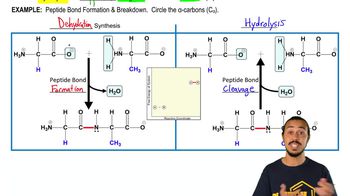
What is the general formula for a peptide bond in a polypeptide backbone?
The general formula is -CO-NH- between adjacent amino acids.
What type of covalent linkage is a peptide bond between amino acids?
A peptide bond is an amide covalent linkage between neighboring amino acids in a polypeptide chain.
How does the number of peptide bonds in a polypeptide relate to the number of amino acids?
The number of peptide bonds is always one less than the number of amino acids in the chain.
What type of reaction forms a peptide bond, and what is released during this process?
Peptide bond formation occurs via dehydration synthesis, which releases a molecule of water.
Is peptide bond formation endergonic or exergonic, and what does this mean?
Peptide bond formation is endergonic, meaning it requires an input of energy, typically from ATP.
What is the reverse process of peptide bond formation called, and what does it do?
The reverse process is called hydrolysis, and it breaks peptide bonds by adding water.
How can you identify a peptide bond in a polypeptide backbone?
A peptide bond can be identified by a carbonyl group linked directly to a nitrogen atom in the backbone.
Why are peptide bonds stable in proteins even though their hydrolysis is exergonic?
Peptide bonds are stable because hydrolysis, while exergonic, has a high energy barrier and thus occurs very slowly.
What groups of two amino acids interact to form a peptide bond?
The carboxyl group of one amino acid interacts with the amino group of another to form a peptide bond.
What is the general formula for a peptide bond in a polypeptide backbone?
The general formula is -CO-NH- between adjacent amino acids.
What type of molecules are linked together by a peptide bond?
Peptide bonds link neighboring amino acids together in a polypeptide chain.
In what type of chain are amino acids linked together by peptide bonds?
Amino acids are linked together by peptide bonds in a polypeptide chain.
What molecule is released during the formation of a peptide bond?
Water (H₂O) is released during the formation of a peptide bond.
What is the primary function of a peptide bond in proteins?
The primary function of a peptide bond is to covalently link amino acids together, forming the backbone of polypeptide chains and proteins.
During the formation of a peptide bond, what is produced as a byproduct?
Water is produced as a byproduct during peptide bond formation.
What is a polypeptide?
A polypeptide is a chain of amino acids linked together by peptide bonds.
How would you define a peptide bond?
A peptide bond is an amide covalent linkage formed between the carboxyl group of one amino acid and the amino group of another in a polypeptide chain.
What role do peptide bonds play in protein structure?
Peptide bonds connect amino acids in a specific sequence, forming the primary structure of proteins.
What are peptide bonds?
Peptide bonds are covalent amide linkages that join amino acids together in a polypeptide chain.
Describe the peptide bond.
The peptide bond is a covalent amide linkage between the carbonyl group of one amino acid and the nitrogen atom of another, forming the backbone of polypeptides.
What is a peptide bond?
A peptide bond is a covalent bond formed between the carboxyl group of one amino acid and the amino group of another, resulting in the release of water.
How is a peptide bond formed between two amino acids?
A peptide bond is formed through a dehydration synthesis reaction, where the carboxyl group of one amino acid reacts with the amino group of another, releasing water and forming an amide linkage.
What is the process by which peptide bonds are formed?
Peptide bonds are formed by dehydration synthesis, an endergonic process that requires energy (ATP) and results in the release of water.