Skip to main content
Biochemistry
My Course
Learn
Exam Prep
AI Tutor
Study Guides
Flashcards
Explore
Try the app
My Course
Learn
Exam Prep
AI Tutor
Study Guides
Flashcards
Explore
Try the app
Back
Polar Amino Acids definitions
You can tap to flip the card.
Hydrophilicity
You can tap to flip the card.
👆
Hydrophilicity
Affinity for water due to electronegative atoms at the ends of side chains, enabling interaction with aqueous environments.
Track progress
Control buttons has been changed to "navigation" mode.
1/14
Related flashcards
Related practice
Recommended videos
Polar Amino Acids quiz #1
Polar Amino Acids
11 Terms
Polar Amino Acids
3. Amino Acids
7 problems
Topic
Charged Amino Acids
3. Amino Acids
7 problems
Topic
3. Amino Acids - Part 1 of 3
5 topics
15 problems
Chapter
3. Amino Acids - Part 2 of 3
5 topics
14 problems
Chapter
3. Amino Acids - Part 3 of 3
7 topics
16 problems
Chapter
Guided course
11:13
Polar Amino Acids
2117
views
37
rank
1
comments
Terms in this set (14)
Hide definitions
Hydrophilicity
Affinity for water due to electronegative atoms at the ends of side chains, enabling interaction with aqueous environments.
R Group
Variable side chain in amino acids responsible for unique chemical properties and interactions.
Serine
Contains a hydroxyl group attached to its side chain, making it capable of hydrogen bonding and water interaction.
Threonine
Features a hydroxyl and a methyl group on its side chain, allowing for hydrogen bonding and increased structural complexity.
Cysteine
Has a thiol group in its side chain, enabling unique chemical reactivity and potential for disulfide bond formation.
Asparagine
Possesses an amide group in its side chain, facilitating hydrogen bonding and polar interactions.
Glutamine
Side chain includes an amide group and an additional methylene unit, enhancing its polar nature and flexibility.
Hydrogen Bonding
Interaction between polar groups in amino acid side chains and water, crucial for protein structure and function.
Alcohol Group
Hydroxyl-containing functional group present in serine and threonine, contributing to polarity and hydrogen bonding.
Thiol Group
Sulfur-containing functional group in cysteine, important for chemical reactivity and protein stabilization.
Amide Group
Functional group with a carbonyl and nitrogen, found in asparagine and glutamine, enabling polar interactions.
Methylene Group
Extra CH2 unit in glutamine's side chain, distinguishing it from asparagine and affecting its structure.
One Letter Code
Single-character abbreviation used to identify amino acids in protein sequences, aiding memorization and notation.
Three Letter Code
Shortened three-character identifier for amino acids, commonly used in biochemistry for clarity and reference.
 BackBack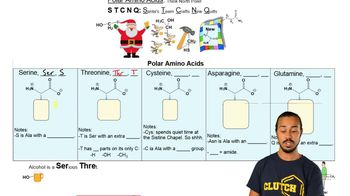
 11:13
11:13