Back

Post Translational Modification definitions

Control buttons has been changed to "navigation" mode.
1/14
  • Post-translational Modification

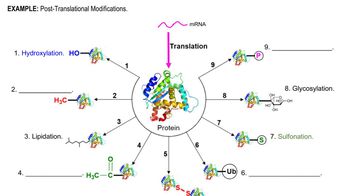
    Covalent alteration made to a protein after translation, crucial for controlling protein activity and function.
  • Methylation

    Addition of a methyl group to a protein, often influencing its activity or interactions with other molecules.
  • Acetylation

    Attachment of an acetyl group to a protein, which can affect protein stability and regulatory functions.
  • Ubiquitination

    Covalent addition of a small protein called ubiquitin, marking proteins for degradation or altering their cellular location.
  • Phosphorylation

    Addition of a phosphate group to a protein, commonly used to regulate enzyme activity and signal transduction.
  • Hydroxylation

    Incorporation of a hydroxyl group into a protein, often modifying its structural properties or stability.
  • Lipidation

    Attachment of a lipid molecule to a protein, facilitating membrane association or signaling roles.
  • Disulfide Bond

    Covalent linkage between two cysteine residues, stabilizing protein structure or connecting polypeptide chains.
  • Sulfonation

    Addition of a sulfate group to a protein, which can influence protein interactions and function.
  • Glycosylation

    Attachment of a carbohydrate group to a protein, affecting folding, stability, and cell recognition.
  • Proteolytic Cleavage

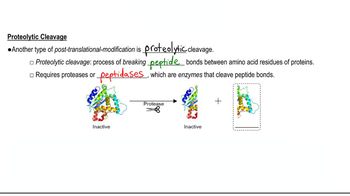
    Breakage of peptide bonds within a protein by proteases or peptidases, often activating or deactivating the protein.
  • Protease

    Enzyme responsible for cleaving peptide bonds in proteins, enabling activation or processing of protein molecules.
  • Peptidase

    Enzyme that specifically targets peptide bonds, facilitating protein maturation or degradation.
  • Zymogen

    Inactive precursor form of a protein that requires proteolytic cleavage for activation.