What is the most effective fuel source for producing ATP in terms of energy yield?
The most effective fuel source for producing ATP is a molecule with a high phosphoryl group transfer potential, such as phosphocreatine, which has a more negative ΔG of hydrolysis than ATP itself.
What are the three main structural components of an ATP molecule?
The three parts of an ATP molecule are an adenine base, a ribose sugar, and three phosphate groups.
Does ATP store energy, and if so, how is this energy utilized in the cell?
Yes, ATP stores energy in the high-energy phosphate bonds, particularly between the second and third phosphate groups. This energy is released during hydrolysis and used to drive cellular processes.
List and describe the three structural components of ATP.
ATP consists of an adenine base, a ribose sugar, and three phosphate groups.
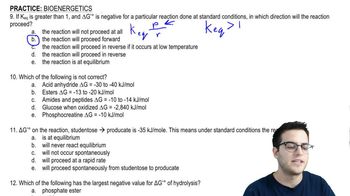
What does a negative ΔG indicate about the spontaneity of a biochemical reaction?
A negative ΔG means the reaction will proceed spontaneously in the forward direction. It does not provide information about the reaction rate.
How does amplification function in signal transduction pathways?
Amplification allows a single signaling molecule to trigger the production of many downstream molecules, greatly increasing the cellular response. Each step in the pathway can further amplify the signal.
What is the significance of Keq being equal to 1 in a chemical reaction?
Keq equal to 1 means the rates of product formation and reactant disappearance are the same, indicating the reaction is at equilibrium. At this point, ΔG is zero.
Why can some reactions with a positive standard ΔG still occur in cells?
Cellular concentrations of substrates and products can shift the actual ΔG to zero or negative, allowing the reaction to proceed. This is seen in reactions like malate dehydrogenase under certain cellular conditions.
What is the role of adaptation in signal transduction systems?
Adaptation allows cells to attenuate their response to a signal, often through feedback mechanisms such as removing receptors from the membrane. This helps regulate the intensity and duration of the cellular response.
Which class of molecules typically has the largest negative ΔG of hydrolysis?
Acid anhydrides, including ATP, generally have the largest negative ΔG of hydrolysis. Their values can range from about -30 kJ/mol or more.