Back

Practice - Biosignaling definitions

Control buttons has been changed to "navigation" mode.
1/15
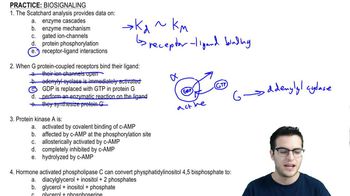
  • Receptor-ligand interactions

    Molecular recognition events that determine specificity and strength of signal transmission, quantified by dissociation constant.
  • Dissociation constant

    Numerical value reflecting affinity between receptor and ligand; lower values indicate tighter binding.
  • G protein-coupled receptor

    Membrane protein that triggers intracellular signaling by activating G proteins upon ligand binding.
  • GTPase

    Enzyme activity in G proteins responsible for hydrolyzing GTP to GDP, regulating signal duration.
  • Adenyl cyclase

    Enzyme activated by G proteins that catalyzes conversion of ATP to cyclic AMP, amplifying cellular signals.
  • Cyclic AMP

    Second messenger molecule that allosterically activates protein kinase A, modulating cellular responses.
  • Protein kinase A

    Enzyme regulated by cyclic AMP, releases catalytic subunit to phosphorylate target proteins.
  • Phospholipase C

    Enzyme that cleaves PIP2 into DAG and IP3, initiating calcium release and protein kinase C activation.
  • Diacylglycerol

    Lipid-derived molecule produced by phospholipase C, acts as a co-activator for protein kinase C.
  • Inositol triphosphate

    Soluble molecule generated from PIP2 hydrolysis, triggers release of calcium from intracellular stores.
  • Protein kinase C

    Enzyme activated by diacylglycerol and calcium, phosphorylates proteins to propagate cellular signals.
  • Receptor tyrosine kinase

    Transmembrane protein that autophosphorylates upon dimerization and ligand binding, using ATP.
  • Autophosphorylation

    Self-catalyzed addition of phosphate groups to a protein, often required for full activation.
  • Protein kinase B

    Enzyme mediating insulin signaling, activates glycogen synthase and promotes GLUT4 translocation.
  • Carrier protein

    Transport molecule in blood that binds hydrophobic steroid hormones, enabling their circulation in aqueous environments.