Back

Practice - Membrane Structure 1 quiz

Control buttons has been changed to "navigation" mode.
1/15
  • Which enzyme specifically removes an unsaturated fatty acid from the 2-position of a phospholipid?

    Phospholipase A2 removes an unsaturated fatty acid from the 2-position of a phospholipid.
  • Where is the unsaturated fatty acid typically located in a phospholipid?

    The unsaturated fatty acid is usually found at the 2-position of a phospholipid.
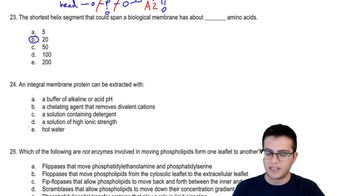
  • How many amino acids are typically required for a helix to span a membrane?

    A membrane-spanning helix is typically about 20 amino acids long.
  • Why are detergents necessary to extract integral membrane proteins?

    Detergents are needed because integral membrane proteins have hydrophobic regions that interact with the membrane, and detergents help solubilize these regions.
  • What structural feature allows detergents to interact with membrane proteins?

    Detergents have both hydrophobic tails and hydrophilic heads, allowing them to interact with both regions of membrane proteins.
  • What is the function of flippases in the membrane?

    Flippases move phospholipids from the outer leaflet to the inner leaflet of the membrane.
  • What is the function of floppases in the membrane?

    Floppases move phospholipids from the inner (cytosolic) leaflet to the outer leaflet of the membrane.
  • What is the role of scramblases in membrane phospholipid movement?

    Scramblases move phospholipids in both directions, disrupting membrane asymmetry.
  • Is 'flip flop base' a real enzyme involved in phospholipid movement?

    'Flip flop base' is not a real enzyme; the correct enzymes are flippases, floppases, and scramblases.
  • How do you calculate the mole ratio of lipid to protein in a membrane given their masses and molecular weights?

    Divide the mass of each component by its molecular weight to get moles, then divide the moles of lipid by the moles of protein.
  • If a membrane is 45% phospholipid and 55% protein by weight, with molecular weights of 750 and 60,000 Daltons respectively, what is the approximate mole ratio of lipid to protein?

    The mole ratio of lipid to protein is approximately 65.
  • What is the typical molecular weight of a phospholipid used in mole ratio calculations?

    The typical molecular weight of a phospholipid used is about 750 Daltons.
  • What is the typical molecular weight of a membrane protein used in mole ratio calculations?

    The typical molecular weight of a membrane protein used is about 60,000 Daltons.
  • What property of integral membrane proteins makes them difficult to extract without detergents?

    Their amphipathic nature, with both hydrophobic and hydrophilic regions, makes them difficult to extract without detergents.
  • Why is understanding the movement of phospholipids across membrane leaflets important?

    It is important for maintaining membrane asymmetry and proper membrane function.