Back

Practice - Membrane Structure 2 definitions

Control buttons has been changed to "navigation" mode.
1/13
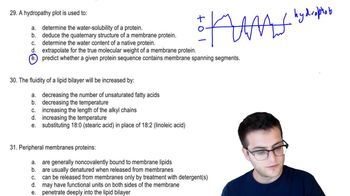
  • Hydropathy Plot

    Graphical tool indicating hydrophobic and hydrophilic regions in protein sequences, used to predict membrane-spanning segments.
  • Membrane-Spanning Segment

    Protein region, typically about 20 amino acids, that integrates into the lipid bilayer, identified by hydrophobicity.
  • Lipid Bilayer

    Double-layered structure forming cell membranes, composed of lipids, crucial for membrane fluidity and protein localization.
  • Membrane Fluidity

    Property describing how easily lipids and proteins move within the membrane, influenced by temperature and fatty acid composition.
  • Unsaturated Fatty Acid

    Lipid component with double bonds, lowering melting point and increasing membrane fluidity.
  • Saturated Fatty Acid

    Lipid component without double bonds, raising melting point and decreasing membrane fluidity.
  • Alkyl Chain

    Hydrocarbon tail in lipids; longer chains increase melting point and reduce membrane fluidity.
  • Peripheral Membrane Protein

    Protein loosely attached to one side of the membrane, associating non-covalently, often via hydrophobic interactions.
  • Hydrophobic Interaction

    Non-covalent association between molecules or regions that avoid water, key for protein-membrane binding.
  • Hydrophilic Segment

    Protein region favoring interaction with water, identified in hydropathy plots as negative regions.
  • Melting Point

    Temperature at which a lipid transitions from solid to liquid, affecting membrane fluidity.
  • Transmembrane Protein

    Protein that penetrates deeply and spans the entire lipid bilayer, often with functional units on both sides.
  • Phospholipase

    Enzyme family involved in lipid metabolism, with types A1, A2, C, and D, but not B1.