Back

Practice - Membrane Transport 1 quiz

Control buttons has been changed to "navigation" mode.
1/15
  • What ions does the NaK ATPase pump transport and in which direction?

    The NaK ATPase pump transports 3 Na+ ions out of the cell and 2 K+ ions into the cell per ATP hydrolyzed.
  • What is the net effect of the NaK ATPase pump on membrane charge?

    It creates a net positive charge outside the cell and a net negative charge inside due to the unequal movement of Na+ and K+ ions.
  • What molecule is hydrolyzed by the NaK ATPase during its transport cycle?

    ATP is hydrolyzed to ADP and inorganic phosphate during each transport cycle.
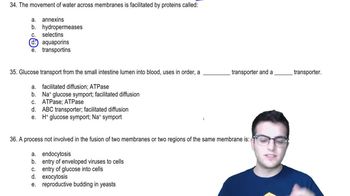
  • What type of protein facilitates rapid water movement across cell membranes?

    Aquaporins are channel proteins that selectively allow water to pass through membranes quickly.
  • Why are aquaporins essential for life?

    Aquaporins enable water to cross membranes much faster than simple diffusion, supporting vital cellular processes.
  • How does glucose enter intestinal cells from the lumen?

    Glucose enters via a sodium-glucose symport, which uses the Na+ gradient to import glucose against its concentration gradient.
  • What maintains the sodium gradient necessary for glucose absorption in the intestine?

    The NaK ATPase pump maintains the sodium gradient by pumping Na+ out of the cell and K+ in.
  • How does glucose move from intestinal cells into the blood?

    Glucose moves into the blood by facilitated diffusion, traveling down its concentration gradient.
  • What is the difference between facilitated diffusion and active transport?

    Facilitated diffusion moves substances down their concentration gradient without energy, while active transport moves them against the gradient using energy.
  • Which membrane transport process does NOT involve membrane fusion?

    Entry of glucose into the cell does not involve membrane fusion; it occurs through channels or transporters.
  • What is endocytosis?

    Endocytosis is a membrane fusion process where the cell membrane pinches inward to engulf substances.
  • What is exocytosis?

    Exocytosis is a membrane fusion process where vesicles fuse with the cell membrane to release contents outside the cell.
  • How do enveloped viruses enter cells?

    Enveloped viruses enter cells by fusing with the cell membrane, incorporating some membrane as they enter.
  • What is reproductive budding in yeast and how does it relate to membrane fusion?

    Reproductive budding in yeast involves membrane fusion as new cells bud off from the parent cell.
  • What are the kinetic constants kt and kd analogous to in enzyme kinetics?

    Kt is analogous to Km (Michaelis constant), and kd is analogous to kcat (turnover number) in enzyme kinetics.