Back

Practice - Nucleic Acids 2 definitions

Control buttons has been changed to "navigation" mode.
1/14
  • Chargaff's Rules

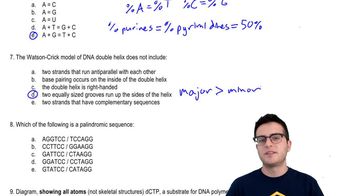
    Principle stating purines and pyrimidines are equal in double-stranded DNA due to specific base pairing.
  • Purine

    Nitrogenous base type found in DNA, includes adenine and guanine, paired with pyrimidines.
  • Pyrimidine

    Nitrogenous base type in DNA, includes cytosine and thymine, paired with purines.
  • Adenine

    Nitrogenous base in DNA that forms pairs with thymine, maintaining base complementarity.
  • Thymine

    Nitrogenous base in DNA that forms pairs with adenine, ensuring equal base ratios.
  • Cytosine

    Nitrogenous base in DNA that forms pairs with guanine, contributing to DNA stability.
  • Guanine

    Nitrogenous base in DNA that forms pairs with cytosine, supporting double-stranded structure.
  • Major Groove

    Larger indentation in DNA helix where proteins commonly bind, crucial for molecular interactions.
  • Minor Groove

    Smaller indentation in DNA helix, less frequently targeted by proteins compared to its counterpart.
  • Palindromic Sequence

    DNA segment reading identically 5' to 3' on both strands, recognized by restriction enzymes.
  • Antiparallel

    Arrangement of DNA strands running in opposite directions, essential for proper base pairing.
  • Nucleotide Numbering

    System assigning numbers to base positions and sugar carbons, aiding in molecular identification.
  • Deoxycytosine Triphosphate

    DNA building block with three phosphates attached to the 5' carbon, vital for synthesis and fidelity.
  • Phosphate Group

    Chemical moiety attached to the 5' carbon of DNA sugar, key for nucleotide linkage and energy.