Pearson+ LogoPearson+ Logo

Prions quiz #1 Flashcards

Back
Prions quiz #1
Control buttons has been changed to "navigation" mode.
1/10
  • What is an infectious protein called, and how does it cause disease?

    An infectious protein is called a prion. Prions are misfolded proteins that can induce normal proteins to also misfold, leading to neurodegenerative diseases known as transmissible spongiform encephalopathies.
  • What does the acronym 'prion' stand for and how is it derived?

    The term 'prion' stands for proteinaceous infectious agent, with its name derived from the initial letters of those words. It highlights that prions are composed solely of misfolded proteins.
  • How do prions differ structurally from viruses and viroids?

    Prions are made only of misfolded proteins, while viruses contain proteins, nucleic acids, and sometimes lipids, and viroids are composed solely of RNA. This makes prions unique among infectious agents.
  • What is the normal cellular form of the prion protein called, and what is its disease-causing counterpart in scrapie?

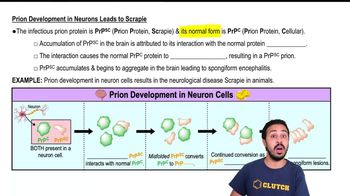
    The normal cellular form is called PrPC, and the disease-causing misfolded form in scrapie is PrPSc. PrPSc interacts with PrPC to induce misfolding.
  • What happens to brain tissue during transmissible spongiform encephalopathies caused by prions?

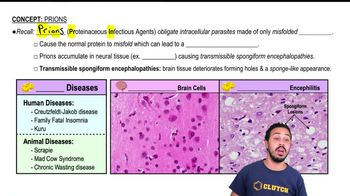
    Brain tissue deteriorates, forming holes that give it a sponge-like appearance. These holes are known as spongiform lesions.
  • Name two prion diseases that affect humans and two that affect animals.

    Human prion diseases include Creutzfeldt-Jakob disease and kuru. Animal prion diseases include scrapie and mad cow syndrome.
  • What is the result of PrPSc accumulation and aggregation in the brain?

    Accumulation and aggregation of PrPSc lead to spongiform lesions in the brain. These lesions contribute to neurological diseases such as scrapie.
  • Describe the process by which PrPSc converts normal PrPC into more PrPSc within neurons.

    PrPSc interacts with normal PrPC, causing it to misfold and convert into PrPSc. This perpetuates a cycle of misfolding and aggregation.
  • What type of cell is primarily affected by prion accumulation in the brain?

    Neurons, which are cells of the nervous system found in the brain, are primarily affected. Prion accumulation in neurons leads to neurological disease.
  • What is the significance of spongiform lesions in diagnosing prion diseases?

    Spongiform lesions are characteristic holes in brain tissue that indicate prion-induced degeneration. Their presence helps diagnose transmissible spongiform encephalopathies.