Back

Pyranose Conformations quiz

Control buttons has been changed to "navigation" mode.
1/15
  • What is a pyranose sugar?

    A pyranose sugar is a cyclic monosaccharide with a six-membered ring structure.
  • What are the two main conformations that pyranose rings can adopt?

    The two main conformations are the chair and boat conformations.
  • Why is the chair conformation more stable than the boat conformation in pyranose rings?

    The chair conformation is more stable because it has lower steric hindrance, especially when bulky groups are in equatorial positions.
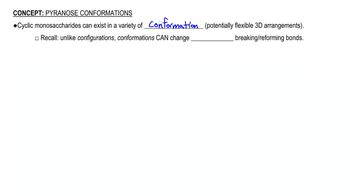
  • What is the difference between a conformation and a configuration?

    A conformation is a flexible 3D arrangement that can change without breaking bonds, while a configuration is a fixed arrangement that requires breaking and reforming bonds to change.
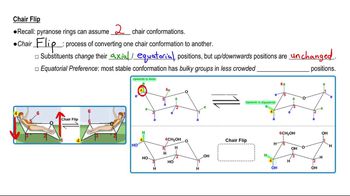
  • What happens to substituents during a chair flip in a pyranose ring?

    During a chair flip, all substituents switch between axial and equatorial positions, but their up or down orientation remains the same.
  • What is meant by 'equatorial preference' in pyranose conformations?

    Equatorial preference means that bulky groups prefer to occupy equatorial positions because these are less crowded and more stable.
  • How does the chair flip affect the stability of pyranose conformations?

    The chair flip can interconvert between two chair conformations, but the one with more bulky groups in equatorial positions is more stable and favored.
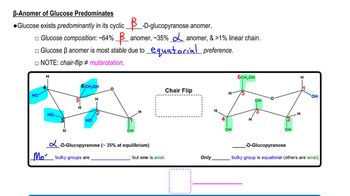
  • What percentage of glucose exists as the beta anomer in solution?

    About 64% of glucose exists as the beta anomer in solution.
  • Why does the beta anomer of glucose predominate in solution?

    The beta anomer predominates because its bulky groups are in equatorial positions, minimizing steric hindrance and increasing stability.
  • What is mutarotation in the context of pyranose sugars?

    Mutarotation is the process that changes the configuration at the anomeric carbon, interconverting alpha and beta forms.
  • How can you distinguish a chair flip from mutarotation?

    A chair flip changes only the conformation (axial/equatorial positions), while mutarotation changes the configuration at the anomeric carbon.
  • In a chair conformation, what is the difference between axial and equatorial positions?

    Axial positions are oriented straight up or down from the ring, while equatorial positions are slanted away from the ring.
  • What happens to the up/down orientation of substituents during a chair flip?

    The up/down orientation of substituents does not change during a chair flip; only their axial/equatorial status changes.
  • Which conformation of glucose is least stable and why?

    The conformation with most bulky groups in axial positions is least stable due to increased steric hindrance.
  • How does equatorial preference influence the equilibrium between different chair conformations?

    Equatorial preference causes the equilibrium to favor the chair conformation with more bulky groups in equatorial positions, making it more prevalent.