Pearson+ LogoPearson+ Logo

Signaling Defects & Cancer quiz #1 Flashcards

Back
Signaling Defects & Cancer quiz #1
Control buttons has been changed to "navigation" mode.
1/10
  • What is the active form of the Ras protein in cell signaling pathways?

    The active form of the Ras protein is when it is bound to GTP (guanosine triphosphate).
  • What role do proto oncogenes play in regulating cell growth?

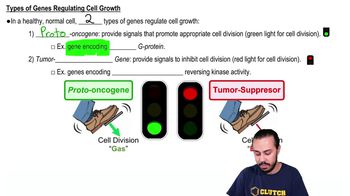
    Proto oncogenes provide signals that promote appropriate cell division, acting as the green light for cell growth. They ensure cell division proceeds at a normal and healthy rate.
  • How do tumor suppressor genes function in cell division?

    Tumor suppressor genes provide signals that inhibit cell division, acting as the red light or brakes for cell growth. They help maintain healthy rates of cell division by suppressing excessive proliferation.
  • What is the consequence of a mutation in a proto oncogene?

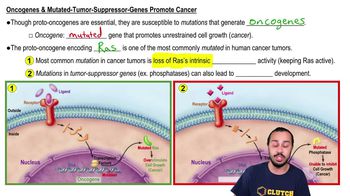
    A mutation in a proto oncogene creates an oncogene, which promotes unrestrained cell growth. This can lead to the development of cancer due to excessive cell proliferation.
  • Why is mutated Ras commonly associated with cancer development?

    Mutated Ras often loses its intrinsic GTPase activity, preventing it from inactivating itself. This keeps Ras in the active state, leading to overstimulation of cell growth and cancer.
  • What happens when tumor suppressor genes are mutated?

    Mutated tumor suppressor genes fail to inhibit cell growth, acting like broken brakes. This inability to suppress cell division can promote cancer development.
  • How do phosphatases act as tumor suppressors in signaling pathways?

    Phosphatases reverse kinase activity by removing phosphate groups, thereby terminating or inhibiting signals that promote cell growth. This helps prevent uncontrolled cell proliferation.
  • What is the effect of a mutated phosphatase on cell growth regulation?

    A mutated phosphatase cannot function properly to remove phosphate groups and inhibit cell growth. This failure allows cell division to proceed unchecked, contributing to cancer.
  • How do transcription factors contribute to cancer when oncogenes are present?

    Transcription factors promote the transcription of oncogenes, leading to the production of mutated proteins like Ras. These mutated proteins drive unrestrained cell growth and cancer.
  • What is the analogy used to describe the function of proto oncogenes and tumor suppressor genes?

    Proto oncogenes are compared to the gas pedal or green light for cell division, while tumor suppressor genes are likened to the brakes or red light. This analogy highlights their roles in promoting and inhibiting cell growth, respectively.