Which enzyme is responsible for digesting starch in the human body?
Amylase is the enzyme responsible for digesting starch.
What is the name of the enzyme produced by the pancreas that digests starch?
The enzyme produced by the pancreas that digests starch is called pancreatic amylase.
What is the role of amylase in carbohydrate digestion?
Amylase breaks down starch into smaller sugar units, facilitating carbohydrate digestion.
Is the enzyme that digests dietary starch found in saliva or produced by the pancreas?
The enzyme that digests dietary starch, amylase, is found both in saliva (salivary amylase) and produced by the pancreas (pancreatic amylase).
What is the function of salivary amylase in starch digestion?
Salivary amylase initiates the breakdown of starch into maltose and smaller polysaccharides in the mouth.
What is the difference between salivary amylase and pancreatic amylase?
Salivary amylase begins starch digestion in the mouth, while pancreatic amylase continues starch digestion in the small intestine.
Which enzyme specifically breaks down starch into maltose and other smaller carbohydrates?
Amylase specifically breaks down starch into maltose and other smaller carbohydrates.
What type of glycosidic linkage is found at the branch points of amylopectin?
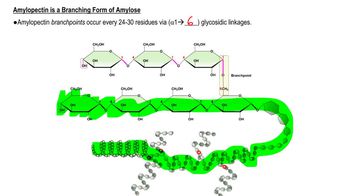
The branch points of amylopectin contain alpha 1→6 glycosidic linkages. These occur on average every 24 to 30 glucose residues.
How does the structure of amylose differ from amylopectin in terms of branching?
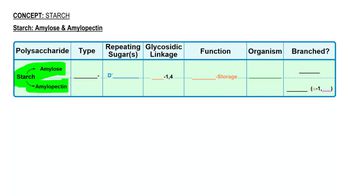
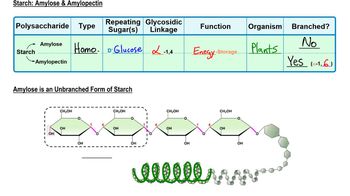
Amylose is completely unbranched and forms linear chains, while amylopectin is branched with side chains. The branches in amylopectin are connected by alpha 1→6 glycosidic bonds.
What is the repeating sugar unit found in both amylose and amylopectin?
Both amylose and amylopectin are composed of repeating D-glucose units. These units are linked primarily by alpha 1→4 glycosidic bonds.