What is the primary function of a transport protein in the context of membrane proteins?
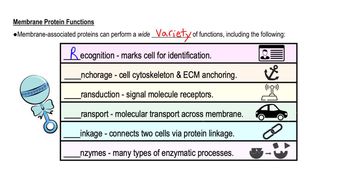
A transport protein facilitates the movement of molecules across the cell membrane, allowing substances to enter or exit the cell and thereby contributing to cellular homeostasis.
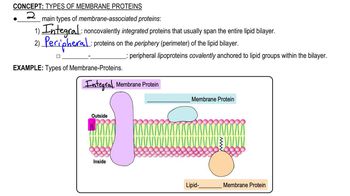
What distinguishes integral membrane proteins from peripheral membrane proteins in terms of their position within the lipid bilayer?
Integral membrane proteins span the entire lipid bilayer, having both extracellular and intracellular portions. Peripheral membrane proteins are located on the periphery and do not span the bilayer.
How are lipid-linked membrane proteins anchored to the membrane?
Lipid-linked membrane proteins are covalently attached to lipid groups within the bilayer. This covalent linkage classifies them as lipoproteins.
What is the role of membrane proteins in cell recognition?
Membrane proteins involved in recognition help identify the cell, allowing immune cells to distinguish healthy cells from foreign invaders. This function is crucial for immune response and cellular identification.
How do membrane proteins contribute to anchorage within a cell?
Membrane proteins involved in anchorage connect the cell and its cytoskeleton to the extracellular matrix (ECM). This provides structural stability and maintains cell positioning.
What is signal transduction in the context of membrane protein function?
Signal transduction refers to membrane proteins acting as receptors that transmit signals between the inside and outside of the cell. This enables cellular communication and response to external stimuli.
How do membrane proteins facilitate linkage between cells?
Membrane proteins can link two cells together through protein linkages, similar to how paper clips connect. This linkage supports tissue formation and intercellular communication.
What enzymatic role can membrane proteins play?
Membrane proteins can function as enzymes, catalyzing and speeding up chemical reactions at the membrane. This is essential for various cellular metabolic processes.
What mnemonic is suggested to remember the general functions of membrane proteins?
The first letters of the functions—recognition, anchorage, transduction, transport, linkage, and enzymatic activity—spell out 'RATTLE.' This mnemonic helps recall the major roles of membrane proteins.
What is the main structural difference between lipid-linked and other peripheral membrane proteins?
Lipid-linked membrane proteins are covalently bonded to lipid groups, whereas other peripheral proteins are not. This covalent attachment makes lipid-linked proteins a distinct subcategory.