 Back
Biochemistry: Atoms, Water, Carbon, and Macromolecules
 03:24

Terms in this set (20)
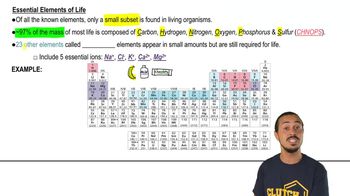
Matter is any substance that occupies space and has mass. An element is a unique form of matter with specific chemical and physical properties that cannot be broken down by ordinary chemical reactions.
Atoms consist of protons and neutrons in the nucleus, and electrons orbiting the nucleus in electron shells.
Protons have a +1 charge and mass of 1 amu, neutrons have no charge and mass of 1 amu, electrons have a -1 charge and negligible mass (~1/1800 amu).
The atomic number is the number of protons. The mass number is the sum of protons and neutrons in the nucleus.
Isotopes are atoms of the same element with the same number of protons but different numbers of neutrons, resulting in different mass numbers.
The octet rule states that atoms are most stable when their outermost electron shell contains eight electrons, except the first shell which is stable with two.
Atoms can gain, lose, or share electrons through chemical bonds to fill their outermost shell and achieve stability.
Ionic bonds form by transfer of electrons creating charged ions. Covalent bonds form by sharing electrons between atoms.
Cations are positively charged ions formed by losing electrons. Anions are negatively charged ions formed by gaining electrons.
A polar covalent bond involves unequal sharing of electrons, creating partial charges. In water, oxygen is partially negative and hydrogen partially positive, making water polar.
Water's polarity allows it to form hydrogen bonds with ions and polar molecules, dissolving them by surrounding and separating particles (hydration shells).
Hydrogen bonding between water molecules requires a lot of energy to change temperature, helping organisms regulate body heat.
Cohesion is attraction between water molecules; adhesion is attraction between water and other surfaces, enabling phenomena like surface tension and capillary action.
pH measures acidity or alkalinity as the negative logarithm of hydrogen ion concentration; low pH means high H+ concentration (acidic), high pH means low H+ (basic).
Buffers absorb excess H+ or OH- ions, stabilizing pH. For example, blood uses the carbonic acid-bicarbonate buffer system to maintain near-neutral pH.
Carbon forms up to four covalent bonds, allowing it to serve as the backbone for complex macromolecules essential to life.
Hydrocarbons are organic molecules made of carbon and hydrogen, storing energy in their covalent bonds and forming linear chains or rings.
Isomers have the same formula but different structures: structural isomers differ in bond arrangement, geometric isomers differ in spatial arrangement around double bonds, and enantiomers are mirror images.
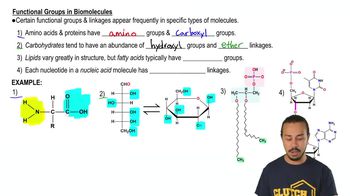
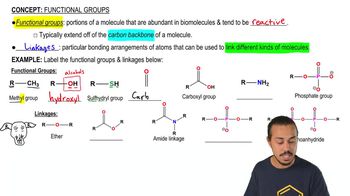
Functional groups are specific atom groups attached to carbon backbones that confer chemical properties and reactivity to molecules.
Dehydration synthesis forms polymers by covalently bonding monomers and releasing water. Hydrolysis breaks polymers into monomers by adding water.