 Back
Biochemistry Exam 2 Key Concepts
 01:34

Terms in this set (23)
Ionization energy is the energy required to remove a valence electron from a neutral atom.
Coulomb's Law explains that ionization energy increases with greater nuclear charge and decreases with increasing atomic radius.
These elements typically form +2 cations by losing two valence electrons.
Use Roman numerals to indicate the metal's oxidation state, e.g., cobalt (III) oxide is Co2O3.
S–Cl bond is slightly polar; S–O bond is polar due to higher electronegativity difference.
The molecule is polar because of the polar S–O bond and asymmetrical shape.
SO3 2− has resonance structures with trigonal pyramidal shape due to lone pairs on sulfur.
Carbon A: 2 H; Carbon B: 1 H; Carbon C: 0 H (due to bonding with other atoms).
Atom A: tetrahedral; Atom B: trigonal planar; Atom C: tetrahedral.
Two isomers: ethanol (alcohol group) and dimethyl ether (ether group), each with distinct smells.
Condensed: NH2(CH2)3COOH; Molecular formula: C4H9NO2.
Amino group (-NH2) and carboxyl group (-COOH) are present in all amino acids.
The O–H bond is the most polar due to the large electronegativity difference.
Side chain polarity depends on functional groups; polar side chains contain electronegative atoms like O or N.
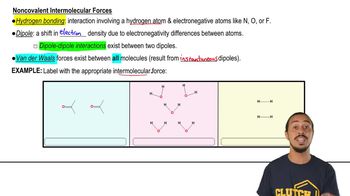
Carbon tetrafluoride: London dispersion; Ethylamine: hydrogen bonding; Acetaldehyde: dipole-dipole interactions.
Fatty acids contain a carboxyl (-COOH) functional group.
Lauric acid: saturated fat; Oleic acid: monounsaturated fat.
Oleic acid is a cis fat, indicated by the kink in its carbon chain at the double bond.
Coconut oil (lauric acid) has stronger IMFs due to saturation and straight chains, making it solid at room temperature.
Valine and isoleucine have nonpolar side chains composed mainly of hydrocarbons.
Valine and isoleucine: London dispersion forces; Lysine and glutamic acid: ionic interactions.
Hydrogen bonding occurs when H is bonded to N, O, or F; other attractions include dipole-dipole and London dispersion.
Lowest to highest: dimethylether < ethoxypropane < pentanol, due to increasing hydrogen bonding and molecular mass.