 Back
Biochemistry: Lipids and Biological Membranes
 02:40

Terms in this set (23)
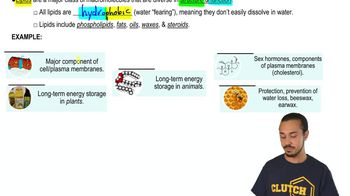
Lipids are organic molecules characterized by low solubility in water, making them hydrophobic.
Energy storage, insulation, water repellency, buoyancy control, membrane structure, enzyme cofactors, signaling molecules, pigments, and antioxidants.
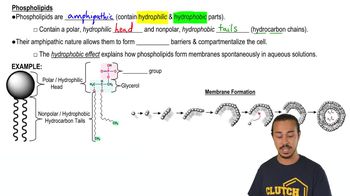
Storage lipids mainly store energy (e.g., triacylglycerols), while membrane lipids form cell membranes and are amphipathic (e.g., glycerophospholipids).
A fatty acid consists of a carboxylic acid group attached to a long hydrocarbon chain (4-36 carbons), usually unbranched and with an even number of carbons.
Saturated fatty acids have no double bonds; unsaturated fatty acids have one or more cis double bonds causing kinks in the chain.
By chain length:number of double bonds(Δposition of double bonds), e.g., 18:1(Δ9) for oleic acid.
A molecule with three fatty acids esterified to a glycerol backbone; primary form of lipid energy storage.
Fats have more reduced carbons (9 kcal/g vs. 4 kcal/g) and are hydrophobic, storing less water and causing less osmotic stress.
Glycerophospholipids, sphingolipids, and sterols; all are amphipathic with hydrophobic tails and hydrophilic heads.
Backbone of L-glycerol-3-phosphate with two fatty acid tails and a polar, charged head group.
A long-chain amino alcohol called sphingosine, not glycerol.
Oligosaccharide head groups on glycosphingolipids determine blood types A, B, AB, or O based on specific glycosyltransferase enzymes.
Four fused rings (steroid nucleus) with a polar hydroxyl group and various nonpolar side chains; cholesterol modulates membrane fluidity.
Oxidized derivatives of sterols, synthesized from cholesterol, acting as signaling molecules.
Vitamin A (vision, growth), D (calcium regulation), E (antioxidant), and K (blood clotting cofactor).
Increasing chain length increases melting point due to stronger hydrophobic interactions.
Double bonds (cis) introduce kinks, reducing packing and lowering melting point.
Trans fats adopt extended conformations like saturated fats, pack tightly, have higher melting points, and increase cardiovascular risk.
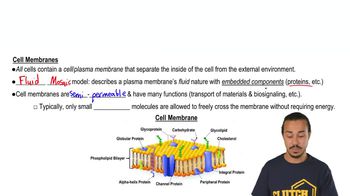
Fatty acid composition (chain length and saturation) and cholesterol content regulate membrane fluidity and phase state.
Peripheral (loosely associated), amphitropic (reversibly associate), and integral (embedded with hydrophobic regions spanning membrane).
Monotopic penetrate one leaflet, bitopic span both leaflets once, polytopic span multiple times.
Passive transport (down gradient), facilitated diffusion (carrier-mediated), and active transport (against gradient using energy).
Primary uses ATP hydrolysis directly; secondary couples transport of one solute down its gradient to drive another solute against its gradient.