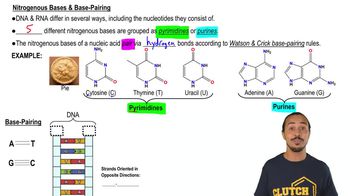
What are the two types of nitrogenous bases in nucleic acids?
Purines (adenine, guanine) with a fused six- and five-member ring, and pyrimidines (cytosine, thymine, uracil) with a single six-member ring.
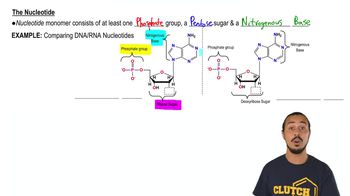
What sugar is found in RNA and DNA nucleotides?
Ribose in RNA and 2’-deoxyribose in DNA; the difference is a hydroxyl group at the 2’ carbon in ribose.
Define a nucleoside.
A molecule composed of a sugar (ribose or deoxyribose) and a nitrogenous base connected by a β-N-glycosidic bond.
How are nucleotides formed?
By adding one or more phosphate groups to a nucleoside, forming a phosphoester bond with the 5’-OH of the sugar.
What is the backbone of DNA composed of?
Alternating units of 2’-deoxyribose sugar and phosphate groups linked by 3’-5’ phosphodiester bonds.
Describe the base pairing rules in DNA.
Adenine pairs with thymine via two hydrogen bonds, and cytosine pairs with guanine via three hydrogen bonds.
What is the structure of the DNA double helix?
Two antiparallel strands forming a right-handed helix with a diameter of 2.0 nm and one turn every 3.4 nm (10 base pairs).
What forces stabilize the DNA double helix?
Hydrogen bonding between base pairs and base stacking interactions involving van der Waals and dipole-dipole forces.
What is the difference between B-DNA, A-DNA, and Z-DNA?
B-DNA is right-handed with 10 bps/turn; A-DNA is right-handed, wider, with 11 bps/turn; Z-DNA is left-handed with 12 bps/turn and a zigzag backbone.
What is a palindrome in DNA sequences?
A sequence with twofold symmetry that reads the same forward and backward on complementary strands, capable of forming hairpin or cruciform structures.
What is the central dogma of molecular biology?
The flow of genetic information: DNA → RNA → Protein via replication, transcription, and translation.
What is semiconservative DNA replication?
Each daughter DNA molecule contains one parental strand and one newly synthesized strand.
In which direction does DNA polymerase synthesize DNA?
In the 5’ to 3’ direction, adding nucleotides to the 3’-OH end of the growing strand.
What are Okazaki fragments?
Short DNA fragments synthesized discontinuously on the lagging strand during DNA replication.
What is the role of DNA ligase in replication?
It seals the phosphodiester bonds between Okazaki fragments to form a continuous DNA strand.
What is the function of RNA polymerase in transcription?
To synthesize RNA from a DNA template by catalyzing phosphodiester bond formation between ribonucleotides.
What are the key promoter elements in prokaryotic transcription?
The -10 (Pribnow box) and -35 regions upstream of the transcription start site, which bind RNA polymerase.
What is the wobble hypothesis in genetic code translation?
The third base of a codon pairs loosely with the first base of the tRNA anticodon, allowing some tRNAs to recognize multiple codons.
What is the role of aminoacyl-tRNA synthetase?
To attach the correct amino acid to its corresponding tRNA, forming aminoacyl-tRNA for protein synthesis.
What are the three stages of translation?
Initiation: assembly of ribosome, mRNA, and initiator tRNA; Elongation: peptide chain extension; Termination: release of completed polypeptide.
 Back
Back
 02:17
02:17