Skip to main content
General Biology
My Course
Learn
Exam Prep
AI Tutor
Study Guides
Textbook Solutions
Flashcards
Explore
Try the app
My Course
Learn
Exam Prep
AI Tutor
Study Guides
Textbook Solutions
Flashcards
Explore
Try the app
Back
Earth's Climate Patterns definitions
You can tap to flip the card.
Climate
You can tap to flip the card.
👆
Climate
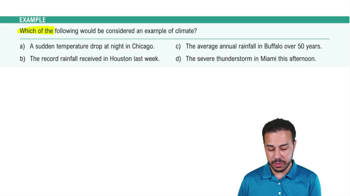
Long-term average of atmospheric conditions in a region, typically measured over years, shaping biogeography and ecosystem distribution.
Track progress
Control buttons has been changed to "navigation" mode.
1/15
Related flashcards
Related practice
Recommended videos
Earth's Climate Patterns exam
Earth's Climate Patterns
29 Terms
Earth's Climate Patterns quiz
Earth's Climate Patterns
15 Terms
Earth's Climate Patterns
48. Ecology
5 problems
Topic
Introduction to Terrestrial Biomes
48. Ecology
5 problems
Topic
48. Ecology - Part 1 of 3
4 topics
12 problems
Chapter
Jason
48. Ecology - Part 2 of 3
4 topics
9 problems
Chapter
48. Ecology - Part 3 of 3
2 topics
5 problems
Chapter
01:36
Earth's Climate Patterns Example 1
1803
views
16
rank
01:36
Earth's Climate Patterns Example 3
1605
views
9
rank
03:01
Earth's Climate Patterns Example 5
1533
views
4
rank
Terms in this set (15)
Hide definitions
Climate
Long-term average of atmospheric conditions in a region, typically measured over years, shaping biogeography and ecosystem distribution.
Weather
Short-term atmospheric conditions, including temperature, precipitation, cloud cover, and wind, often variable and unpredictable.
Latitude
Imaginary horizontal lines measuring distance north or south from the equator, influencing sunlight angle and climate.
Equator
Earth's midline at 0° latitude, receiving the most direct sunlight and highest energy per unit area, resulting in a hot climate.
Axial Tilt
Earth's 23.5° tilt relative to its orbital plane, responsible for seasonal changes in temperature and precipitation.
Hadley Cell
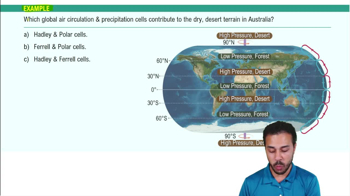
Large-scale atmospheric circulation between the equator and 30° latitude, creating rainforests and deserts through rising and descending air.
Coriolis Effect
Deflection of moving air and objects due to Earth's rotation, curving prevailing winds and influencing ocean currents.
Prevailing Winds
Consistent, long-term surface winds in a region, shaped by pressure differences and Earth's rotation.
Gyre
Massive system of circulating ocean currents, transferring heat from the equator toward the poles and balancing global temperatures.
Specific Heat
Property of water allowing it to resist temperature changes, stabilizing nearby land climates and moderating extremes.
Rain Shadow
Dry, desert-like area on the leeward side of a mountain range, formed as moist air loses precipitation on the windward side.
Photosynthesis
Process in forests converting solar energy to chemical energy and removing atmospheric carbon dioxide, contributing to climate cooling.
Transpiration
Release of water vapor from plant leaves, forming clouds that block solar radiation and promote precipitation, cooling the environment.
Carbon Dioxide
Greenhouse gas absorbed by water and forests, influencing Earth's heat retention and climate regulation.
Surface Air Pressure
Force exerted by the atmosphere at Earth's surface, varying with latitude and driving patterns of precipitation and wind.
 BackBack
 01:36
01:36