Back

Non-Random Mating definitions

Control buttons has been changed to "navigation" mode.
1/13
  • Non-Random Mating

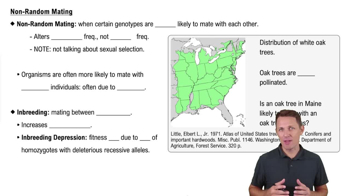
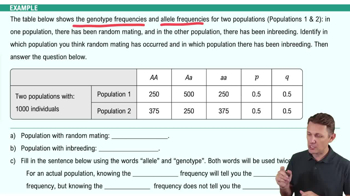
    Occurs when certain genotypes preferentially mate, altering genotype frequencies but not allele frequencies in a population.
  • Genotype Frequency

    Represents the proportion of different genetic combinations present within a population.
  • Allele Frequency

    Describes the relative abundance of a specific genetic variant within a population's gene pool.
  • Hardy-Weinberg Equilibrium

    A theoretical state where genotype and allele frequencies remain constant across generations in the absence of evolutionary forces.
  • Inbreeding

    Mating between closely related individuals, often due to proximity, leading to increased homozygosity.
  • Homozygosity

    A measure indicating the proportion of individuals with two identical alleles for a given gene in a population.
  • Inbreeding Depression

    A reduction in fitness caused by increased expression of harmful recessive alleles due to excess homozygotes.
  • Deleterious Recessive Allele

    A genetic variant that, when present in two copies, can cause harmful effects or reduced fitness.
  • Sexual Selection

    A process where certain traits increase an individual's ability to obtain mates, distinct from non-random pairing.
  • Natural Selection

    A mechanism that changes allele frequencies by favoring traits that enhance survival or reproduction.
  • Homozygote

    An individual possessing two identical alleles for a specific gene.
  • Wind Pollination

    A reproductive strategy where pollen is dispersed by air currents, often limiting mating to nearby individuals.
  • Population Dynamics

    The study of changes in population size, structure, and genetic composition over time.