Back

Ch. 10 - Hypothesis Testing for Two Samples in Business Statistics

Control buttons has been changed to "navigation" mode.
1/20
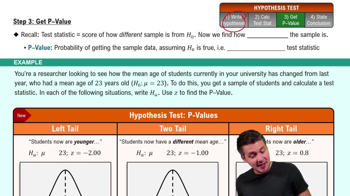
  • What is the decision rule for a two-tail hypothesis test using the t-test?

    Reject H0 if \(|t_x| > t_{\alpha/2}\). Do not reject H0 if \(|t_x| \leq t_{\alpha/2}\).
  • What is the decision rule for a one-tail upper hypothesis test using the t-test?

    Reject H0 if \(t_x > t_\alpha\). Do not reject H0 if \(t_x \leq t_\alpha\).
  • What is the decision rule for a two-tail hypothesis test using the z-test?

    Reject H0 if \(|z_x| > z_{\alpha/2}\). Do not reject H0 if \(|z_x| \leq z_{\alpha/2}\).
  • What is the decision rule for a one-tail upper hypothesis test using the z-test?

    Reject H0 if \(z_x > z_\alpha\). Do not reject H0 if \(z_x \leq z_\alpha\).
  • When comparing two population means with known population standard deviations, which test is used?

    Use the z-test to compare means of two independent samples when population standard deviations are known.
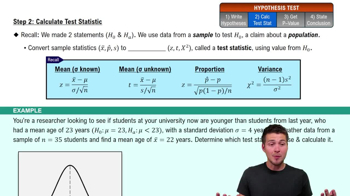
  • Formula for the test statistic when comparing two means with known population standard deviations.

    Test statistic: \(z = \frac{(\bar{x}_1 - \bar{x}_2) - (\mu_1 - \mu_2)}{\sqrt{\frac{\sigma_1^2}{n_1} + \frac{\sigma_2^2}{n_2}}}\)
  • What test is used when population standard deviations are unknown but assumed equal?

    Use the two-sample t-test with pooled variance when population standard deviations are unknown but assumed equal.
  • Formula for pooled variance in two-sample t-test with equal variances.

    Pooled variance: \(s_p^2 = \frac{(n_1 - 1)s_1^2 + (n_2 - 1)s_2^2}{n_1 + n_2 - 2}\)
  • Formula for the test statistic in two-sample t-test with equal variances.

    Test statistic: \(t = \frac{(\bar{x}_1 - \bar{x}_2) - (\mu_1 - \mu_2)}{s_p \sqrt{\frac{1}{n_1} + \frac{1}{n_2}}}\)
  • What test is used when population standard deviations are unknown and not assumed equal?

    Use the two-sample t-test with unequal variances (Welch's t-test) when population standard deviations are unknown and not assumed equal.
  • How is the degrees of freedom calculated for unequal variances t-test?

    Degrees of freedom are calculated using a formula based on sample variances and sizes, often approximated by the Welch-Satterthwaite equation.
  • What test is used to compare two population proportions from independent samples?

    Use the two-sample z-test for proportions to compare proportions between two independent populations.
  • Formula for the standard error when comparing two population proportions.

    Standard error: \(\sigma = \sqrt{\hat{p}(1 - \hat{p}) \left( \frac{1}{n_1} + \frac{1}{n_2} \right)}\), where \(\hat{p}\) is the pooled proportion.
  • Formula for the test statistic when comparing two population proportions.

    Test statistic: \(z = \frac{(\hat{p}_1 - \hat{p}_2) - (p_1 - p_2)}{\sigma}\)
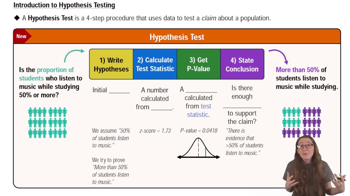
  • What are the key steps in hypothesis testing for two samples?

    1. Identify null and alternative hypotheses. 2. Set significance level. 3. Determine critical value. 4. Calculate test statistic. 5. Compare test statistic to critical value. 6. State conclusion.
  • What does rejecting the null hypothesis imply in two-sample tests?

    Rejecting H0 means there is sufficient evidence to support a difference between the two population parameters.
  • What does failing to reject the null hypothesis imply in two-sample tests?

    Failing to reject H0 means there is insufficient evidence to support a difference between the two population parameters.
  • What assumptions should be checked before applying two-sample hypothesis tests?

    Check assumptions of normality, independence, and equal variances (if applicable) before applying tests.
  • When is a two-tail test appropriate?

    Use a two-tail test when testing for any difference between two parameters without specifying direction.
  • When is a one-tail test appropriate?

    Use a one-tail test when testing for a difference in a specific direction (greater or less).