FPC adjusts the standard error when the sample size is a significant fraction of the population (n/N > 0.05), calculated as \(\sqrt{\frac{N-n}{N-1}}\).
When to use t-distribution for confidence intervals?
Use the t-distribution when σ is unknown and the population is normally distributed, replacing σ with sample standard deviation s.
Formula for confidence interval when σ is unknown?
Confidence interval = sample mean ± critical t-score × (s / √n), with degrees of freedom df = n - 1.
Conditions for approximating binomial distribution with normal distribution?
Sample size must satisfy np ≥ 5 and n(1-p) ≥ 5.
Formula for confidence interval for a population proportion?
When to apply finite population correction for proportions?
Apply FPC when the sample is a significant fraction of the population, adjusting the standard error accordingly.
What affects the width of a confidence interval?
The confidence level, sample size, and variability in the data affect the width of the confidence interval.
Summary: When to use z vs t distributions?
Use z-distribution when σ is known; use t-distribution when σ is unknown and population is normal.
What is the significance level (α) in confidence intervals?
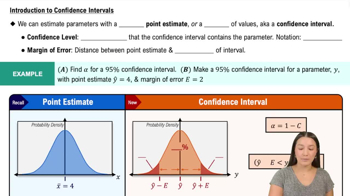
The significance level α is the probability that the confidence interval does not contain the true population parameter, equal to 1 minus the confidence level.
Example: Calculate 90% CI for mean with σ known, n=35, mean=145.5, σ=30.2.
Standard error = 30.2/√35 ≈ 5.105; critical z = 1.645; CI = 145.5 ± 1.645 × 5.105 = (137.10, 153.90).
Example: Calculate 95% CI for mean with σ unknown, n=15, mean=5.11, s=0.85.
Standard error = 0.85/√15 ≈ 0.2195; critical t (df=14) = 2.145; CI = 5.11 ± 2.145 × 0.2195 = (4.64, 5.58).
Example: Calculate 98% CI for proportion with n=100, successes=22.
Sample proportion p = 0.22; standard error = √(0.22×0.78/100) = 0.041; critical z = 2.33; CI = 0.22 ± 2.33 × 0.041 = (0.124, 0.316).
 Back
 04:46