 Back
Ch 9 - Hypothesis Testing for a single population
 05:12

Terms in this set (23)
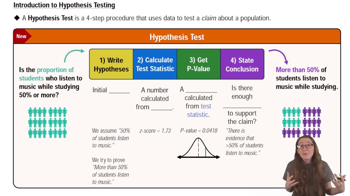
The null hypothesis (H0) represents the status quo or a statement of no effect.
The alternative hypothesis (H1) represents the claim or effect the researcher is testing for.
The significance level (α) is the probability threshold for rejecting H0, commonly set at 0.01, 0.05, or 0.10.
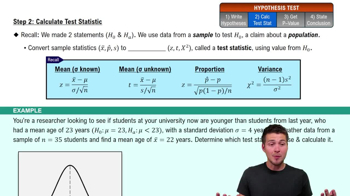
A test statistic is a standardized value (z or t) calculated from sample data to compare against critical values.
The critical value is the cutoff value from statistical tables that determines the rejection region for H0.
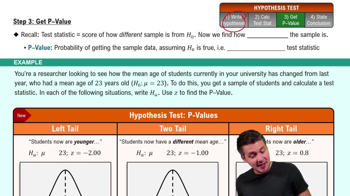
The p-value is the probability of observing a test statistic as extreme as, or more extreme than, the sample result assuming H0 is true.
A two-tailed test is used when the alternative hypothesis is H1: μ ≠ μ0, testing for any difference.
A one-tailed upper test is used when H1: μ > μ0, testing if the mean is greater than a value.
A one-tailed lower test is used when H1: μ < μ0, testing if the mean is less than a value.
The z-test is used when σ is known and the sample size is large or population is normal.
The t-test is used when σ is unknown, substituting sample standard deviation s, with n-1 degrees of freedom.
\(z=\frac{\bar{x}-\mu_0}{\sigma/\sqrt{n}}\)
\(t=\frac{\bar{x}-\mu_0}{s/\sqrt{n}}\)
Sample size must be large enough: np ≥ 5 and n(1-p) ≥ 5 for normal approximation.
\(z=\frac{\hat{p}-p_0}{\sqrt{\frac{p_0(1-p_0)}{n}}}\)
Type I error (α) is rejecting H0 when it is actually true (false positive).
Type II error (β) is failing to reject H0 when it is false (false negative).
Reject H0 if \(|z| > z_{\alpha/2}\).
Reject H0 if \(z > z_{\alpha}\).
Reject H0 if \(z < -z_{\alpha}\).
Reject H0 if \(|t| > t_{\alpha/2}\) with n-1 degrees of freedom.
Reject H0 if \(t > t_{\alpha}\).
Reject H0 if \(t < -t_{\alpha}\).