Skip to main content
Statistics for Business
My Course
Learn
Exam Prep
AI Tutor
Study Guides
Flashcards
Explore
Try the app
My Course
Learn
Exam Prep
AI Tutor
Study Guides
Flashcards
Explore
Try the app
Back
Hypothesis Testing Concepts in Business Statistics
You can tap to flip the card.
Alpha
You can tap to flip the card.
👆
Alpha
Alpha
is the probability of rejecting the null hypothesis when it is actually true.
Track progress
Control buttons has been changed to "navigation" mode.
1/20
Recommended videos
Guided course
03:21
Type I & Type II Errors Example 1
95
views
1
rank
Guided course
06:02
Type I & Type II Errors
114
views
Terms in this set (20)
Hide definitions
Alpha
Alpha
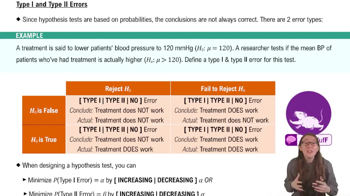
is the probability of rejecting the null hypothesis when it is actually true.
Alternative hypothesis (H1)
The hypothesis that represents the opposite of the null hypothesis and states the population parameter is <, >, or ≠ a specific value.
Beta
Beta
is the probability of failing to reject the null hypothesis when it is actually false.
Consumer’s risk
A Type II error in quality control where the customer receives a product from a faulty process.
Critical sample mean, Xalpha
The sample mean that marks the boundary of the rejection region in hypothesis testing.
Critical sample proportion, p-alpha
The sample proportion that marks the boundary of the rejection region when testing a population proportion.
Hypothesis
An assumption about a population parameter such as a mean or proportion.
Level of significance
The probability of making a Type I error, denoted by alpha.
Null hypothesis (H0)
The status quo hypothesis stating the population parameter is ≤, =, or ≥ a specific value, always including equality.
Observed level of significance (p-value)
The probability of observing a sample mean at least as extreme as the one selected, assuming the null hypothesis is true.
One-tailed hypothesis test
A test where the alternative hypothesis is stated as either < or >.
One-tail (lower) hypothesis test
A test where the alternative hypothesis is stated as <.
One-tail (upper) hypothesis test
A test where the alternative hypothesis is stated as >.
P-value
The probability of observing a sample mean at least as extreme as the one selected, assuming the null hypothesis is true.
Power
The probability that a hypothesis test correctly rejects the null hypothesis.
Power Curve
A curve plotting the power values of a hypothesis test over a range of population means.
Producer’s risk
A Type I error in quality control where the producer detects a problem in the process that does not exist.
Two-tail hypothesis test
A test where the alternative hypothesis is stated as not equal (≠).
Type I error
Rejecting the null hypothesis when it is actually true; probability is alpha.
Type II error
Failing to reject the null hypothesis when it is actually false; probability is beta.
 BackBack
 03:21
03:21