 Back
Key Probability Distributions in Business Statistics
 02:58

Terms in this set (21)
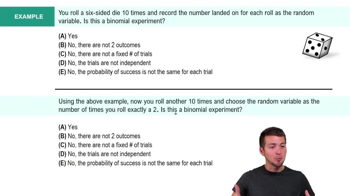
The binomial distribution models the number of successes in a fixed number of independent trials with the same probability of success.
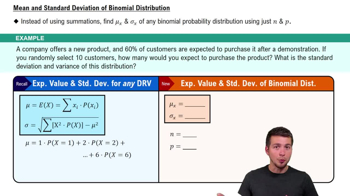
The parameters are n (number of trials) and p (probability of success in each trial).
It is used to model scenarios like the number of defective items in a batch or the number of customers who make a purchase.
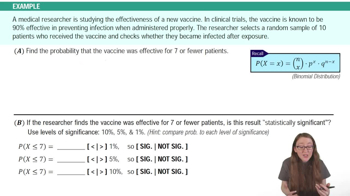
P(X = k) = \(\binom{n}{k} p^{k} (1-p)^{n-k}\), where k is the number of successes.
The Poisson distribution models the number of events occurring in a fixed interval of time or space when events occur independently and at a constant average rate.
The parameter λ (lambda) represents the average number of events in the interval.
It is used for modeling rare events like the number of customer complaints per day or arrivals at a service desk.
P(X = k) = \(\frac{\lambda^{k} e^{-\lambda}}{k!}\), where k is the number of events.
The hypergeometric distribution models the number of successes in draws without replacement from a finite population.
Population size N, number of successes in population K, and number of draws n.
It applies when sampling without replacement, such as quality control inspections from a batch.
P(X = k) = \(\frac{\binom{K}{k} \binom{N-K}{n-k}}{\binom{N}{n}}\), where k is the number of observed successes.
Binomial assumes sampling with replacement or independent trials; hypergeometric assumes without replacement from a finite population.
Events occur independently, at a constant average rate, and two events cannot occur simultaneously.
When n is large and p is small, use Poisson with \(\lambda = np\).
The mean is \(\mu = np\).
The variance is \(\sigma^{2} = np(1-p)\).
The mean is equal to λ.
The variance is also equal to λ.
The mean is \(n \times \frac{K}{N}\).
The variance is \(n \times \frac{K}{N} \times \frac{N-K}{N} \times \frac{N-n}{N-1}\).