 Back
BackStatistics for Business - Chapter 1: Statistics, Data, and Statistical Thinking
 05:53
05:53
Terms in this set (20)
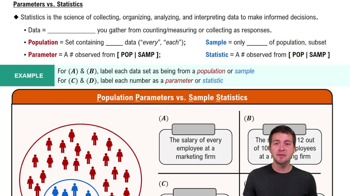
Statistics is the science of collecting, organizing, analyzing, and interpreting data to make informed decisions.
Population is the entire set of data or all subjects of interest. Sample is a subset of the population used to represent it.
A parameter is a numerical value describing a characteristic of a population. A statistic is a numerical value describing a characteristic of a sample.
The average salary of all employees is a parameter because it describes the entire population.
The average salary of 12 employees is a statistic because it describes a sample.
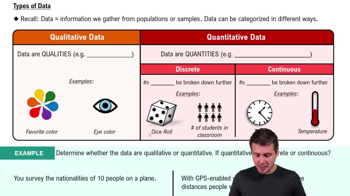
Qualitative data describe qualities or categories (e.g., eye color). Quantitative data represent numerical quantities (e.g., height, weight).
Discrete data are countable and cannot be broken down further (e.g., number of students). Continuous data can take any value within a range (e.g., temperature).
Nationality is qualitative data because it describes categories or qualities.
Distance walked is quantitative continuous data because it can take any value within a range.
Data can be collected by experiments (applying treatments and measuring effects) or observational studies (measuring without intervention).
Yes, experiments allow you to assume causation because treatments are applied and effects measured.
No, observational studies only measure characteristics without intervention, so you cannot assume causation.
Simple random sampling means every subject and every possible group has an equal chance of being selected.
A representative sample has the same proportions of characteristics as the original population.
Systematic sampling selects every k-th subject from the population (e.g., every 12th cookie).
Cluster sampling divides the population into groups (clusters), then randomly selects entire clusters for the sample.
Stratified sampling divides the population into strata with similar characteristics, then randomly samples from each stratum.
Yes, if every marble and group of marbles has an equal chance of selection, it is a simple random sample.
Surveying all customers is a population data set because it includes every individual.
This is an example of systematic sampling, selecting every k-th unit.