 Back
BackStatistics for Business - Probability and Counting
 5:37
5:37
Terms in this set (20)
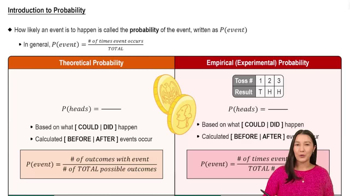
Theoretical probability is the probability based on what could happen, calculated before events occur.
Empirical probability is based on what did happen, calculated after events occur using observed data.
The sample space is the set of all possible outcomes of an experiment or event.
The complement of event A, written as A', is the set of all outcomes where event A does NOT occur.
The total probability is always 1, so \(P(A) + P(A') = 1\).
Mutually exclusive events cannot happen at the same time; their intersection is empty.
For mutually exclusive events, \(P(A \cup B) = P(A) + P(B)\).
Use the addition rule: \(P(A \cup B) = P(A) + P(B) - P(A \cap B)\) to avoid double counting.
Independent events are those where the occurrence of one does not affect the probability of the other.
Multiply their probabilities: \(P(A \cap B) = P(A) \times P(B)\).
A contingency table displays frequencies across two categorical variables to find marginal, joint, and conditional probabilities.
Conditional probability is the probability of event B occurring given that event A has occurred: \(P(B|A) = \frac{P(A \cap B)}{P(A)}\).
Multiply the probability of A by the conditional probability of B given A: \(P(A \cap B) = P(A) \times P(B|A)\).
Bayes' Theorem calculates the probability of an event based on prior knowledge of conditions related to the event.
\(P(B|A) = \frac{P(A|B) \times P(B)}{P(A|B) \times P(B) + P(A|B') \times P(B')}\)
When multiple events occur in sequence, multiply the number of options for each event to find total possible outcomes.
\(P(n,r) = \frac{n!}{(n-r)!}\) counts ordered arrangements of r objects from n.
Divide total permutations by factorials of identical objects: \(\frac{n!}{r_1! r_2! \cdots}\).
Permutations consider order important; combinations do not.
\(C(n,r) = \frac{n!}{r!(n-r)!}\) counts unordered selections of r objects from n.