Skip to main content
Calculus
My Course
Learn
Exam Prep
AI Tutor
Study Guides
Textbook Solutions
Flashcards
Explore
Try the app
My Course
Learn
Exam Prep
AI Tutor
Study Guides
Textbook Solutions
Flashcards
Explore
Try the app
Back
Euler's Method quiz
You can tap to flip the card.
What is the main advantage of Euler's method over linear approximation?
You can tap to flip the card.
👆
What is the main advantage of Euler's method over linear approximation?
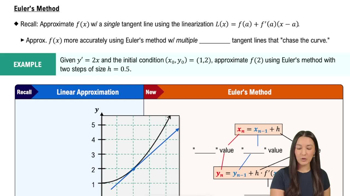
Euler's method uses multiple shorter tangent lines, which provides a more accurate approximation of function values than a single tangent line.
Track progress
Control buttons has been changed to "navigation" mode.
1/15
Related flashcards
Related practice
Recommended videos
Euler's Method definitions
Euler's Method
15 Terms
Euler's Method
13. Intro to Differential Equations
5 problems
Topic
Ally
Separable Differential Equations
13. Intro to Differential Equations
5 problems
Topic
Ally
13. Intro to Differential Equations
4 topics
12 problems
Chapter
Ernest
07:33
Euler's Method
349
views
5
rank
08:09
Euler's Method Example 1
306
views
2
rank
Terms in this set (15)
Hide definitions
What is the main advantage of Euler's method over linear approximation?
Euler's method uses multiple shorter tangent lines, which provides a more accurate approximation of function values than a single tangent line.
What initial information do you need to start Euler's method?
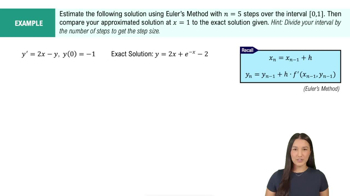
You need a differential equation, an initial condition (x₀, y₀), and a step size h.
How do you calculate the next x-value in Euler's method?
The next x-value is found by adding the step size h to the previous x-value: xₙ = xₙ₋₁ + h.
How do you calculate the next y-value in Euler's method?
The next y-value is found by yₙ = yₙ₋₁ + h * f'(xₙ₋₁, yₙ₋₁), where f' is the derivative given by the differential equation.
In the example y' = 2x with (1, 2) as the initial condition and h = 0.5, what is the first x-value after the initial point?
The first x-value after the initial point is 1.5.
Using the same example, what is the first y-value after the initial point?
The first y-value after the initial point is 3.
How do you evaluate the derivative in Euler's method for y' = 2x?
You substitute the current x-value into the derivative, so f'(x, y) = 2x.
What is the second x-value in the example after two steps?
The second x-value is 2.
What is the approximate value of f(2) using Euler's method with h = 0.5 in the example?
The approximate value of f(2) is 4.5.
How does the Euler's method approximation of f(2) compare to the linear approximation in the example?
Euler's method gives 4.5, which is closer to the actual curve than the linear approximation of 4.
What happens to the accuracy of Euler's method as the step size h decreases?
The accuracy improves; smaller step sizes yield more accurate approximations.
What does each 'step' in Euler's method represent?
Each step represents moving from one point to the next using the tangent line at the current point.
Why might you not always know the actual function curve when using Euler's method?
Because Euler's method is often used when the exact solution to the differential equation is unknown.
What is the general formula for the next y-value in Euler's method?
yₙ = yₙ₋₁ + h * f'(xₙ₋₁, yₙ₋₁).
Why do multiple shorter tangent lines in Euler's method provide a better approximation?
They allow the approximation to follow the curve more closely, reducing the error compared to a single tangent line.
 BackBack
 07:33
07:33