Back

Integrals of Exponential Functions definitions

Control buttons has been changed to "navigation" mode.
1/15
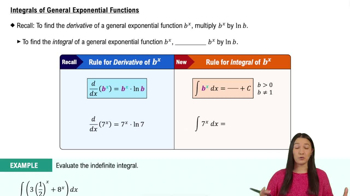
  • Exponential Function

    A mathematical expression where a constant base is raised to a variable exponent, such as b^x.
  • Base

    The constant value in an exponential expression that is raised to a variable power.
  • Natural Logarithm

    A logarithm with base e, often used to simplify expressions involving exponential functions.
  • Constant of Integration

    An arbitrary constant added to indefinite integrals to account for all possible antiderivatives.
  • Indefinite Integral

    An integral without specified limits, representing a family of functions differing by a constant.
  • Sum Rule

    A property allowing the integral of a sum to be written as the sum of the integrals of each term.
  • Constant Multiple Rule

    A property allowing a constant factor to be pulled outside the integral sign for easier computation.
  • Power Rule

    A method for integrating functions where a variable is raised to a constant exponent.
  • e

    A mathematical constant approximately equal to 2.718, serving as the base for natural exponential functions.
  • Derivative

    A process that measures the rate at which a function changes, reversed by integration.
  • Antiderivative

    A function whose derivative yields the original function, found through integration.
  • Restriction

    A condition placed on the base of an exponential function, such as being positive and not equal to one.
  • Logarithm Property

    A rule used to manipulate logarithmic expressions, such as extracting exponents or simplifying fractions.
  • Integration

    The mathematical process of finding the area under a curve or the antiderivative of a function.
  • Function

    A relation where each input is assigned exactly one output, often represented by algebraic expressions.