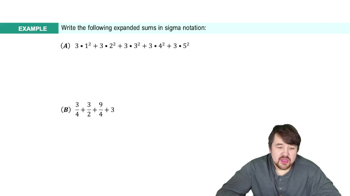
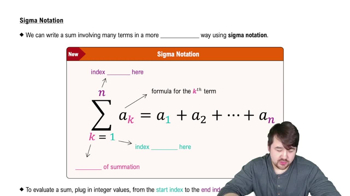
Sigma notation is used to write the sum of many terms in a compact way, which is especially helpful for evaluating finite sums and approximating areas under curves.
In sigma notation, what does the index of summation represent?
The index of summation indicates where to start and end the summation, and it can be any letter, such as k, i, or j.
How do you evaluate a finite sum written in sigma notation?
You plug in integer values from the start to the end of the index into the given equation and add all the resulting terms together.
What does the sum and difference rule for summations state?
The sum and difference rule allows you to split a summation of a sum or difference into two separate summations, making calculations easier.
How does the constant multiple rule apply to summations?
The constant multiple rule allows you to pull a constant factor outside of the summation, so you can multiply the sum by the constant after evaluating it.
How do you evaluate the summation of a constant, such as Σ (from k=1 to n) of c?
You multiply the constant c by the number of terms n, so the result is c × n.
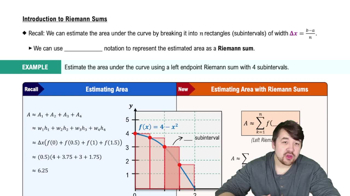
What is a Riemann sum?
A Riemann sum is an approximation of the area under a curve, calculated by summing the areas of rectangles under the curve using sigma notation.
How do you calculate the width of each rectangle (Δx) in a Riemann sum?
The width Δx is calculated as (b - a) / n, where [a, b] is the interval and n is the number of rectangles.
What is the general formula for a left endpoint Riemann sum?
The left endpoint Riemann sum is Σ (from k=1 to n) of f(x_{k-1}) × Δx, where x_{k-1} is the left endpoint of each subinterval.
How does the right endpoint Riemann sum differ from the left endpoint Riemann sum?
The right endpoint Riemann sum uses f(x_k) instead of f(x_{k-1}), evaluating the function at the right endpoint of each subinterval.
How do you find the midpoint for each rectangle in a midpoint Riemann sum?
The midpoint is found by averaging the left and right endpoints: (x_{k-1} + x_k) / 2, and the sum uses f of this value.
What does the general Riemann sum formula with x_k* represent?
It represents a sum where x_k* can be any point in the k-th subinterval, allowing for left, right, or midpoint approximations.
Why is sigma notation useful for Riemann sums?
Sigma notation provides a compact way to express the sum of the areas of rectangles, making calculations and notation more efficient.
If Δx = 0.5, a = 0, and n = 4, what is the interval [a, b]?
Since Δx = (b - a)/n, b = a + n × Δx = 0 + 4 × 0.5 = 2, so the interval is [0, 2].
How do you determine which side (left, right, or midpoint) to use in a Riemann sum?
You choose the side based on the problem's instructions, and adjust the formula inside the summation to use x_{k-1} for left, x_k for right, or (x_{k-1} + x_k)/2 for midpoint.
 Back
Back
 04:22
04:22