A sequence is an ordered list of numbers where each term follows a specific pattern or rule. The order of the numbers is important.
What are the terms in a sequence also called?
Terms in a sequence are also referred to as elements or members of the sequence.
How do you identify if a sequence is finite or infinite?
A finite sequence stops after a certain number of terms, while an infinite sequence continues forever, often indicated by '...'.
What is the difference between the inputs for functions and sequences?
Functions can take any real number as input, but sequences only use positive integers as indexes, starting from 1.
How do you find the nth term of an arithmetic sequence?
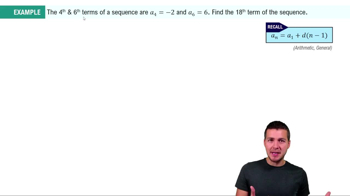
Use the formula an = a1 + d(n-1), where a1 is the first term and d is the common difference.
What is a recursive formula for a sequence?
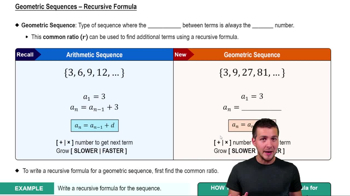
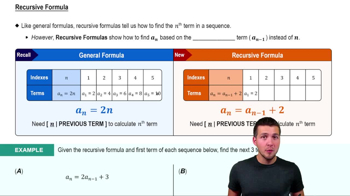
A recursive formula defines each term based on the previous term(s), such as an = an-1 + d for arithmetic sequences.
How do you write a recursive formula for an arithmetic sequence?
The recursive formula is an = an-1 + d, where d is the common difference, and you must specify the first term a1.
What is the common difference in an arithmetic sequence?
The common difference, denoted by d, is the fixed amount added to each term to get the next term.
How do you find the common difference in a sequence?
Subtract any term from the next term (next term minus previous term); the result is the common difference.
What is a geometric sequence?
A geometric sequence is a sequence where each term is found by multiplying the previous term by a constant called the common ratio.
How do you write a recursive formula for a geometric sequence?
The recursive formula is an = an-1 × r, where r is the common ratio, and you must specify the first term a1.
What is the general formula for the nth term of a geometric sequence?
The general formula is an = a1 × r^(n-1), where a1 is the first term and r is the common ratio.
How do you find the common ratio in a geometric sequence?
Divide any term by the previous term (current term divided by previous term); the result is the common ratio r.
Why are general formulas useful for sequences?
General formulas allow you to find any term in the sequence directly without needing to know previous terms, which is especially helpful for large indexes.
What is the main difference between arithmetic and geometric sequences?
Arithmetic sequences add a constant difference to each term, while geometric sequences multiply each term by a constant ratio.
 Back
Back
 5:59
5:59