Skip to main content
Calculus
My Course
Learn
Exam Prep
AI Tutor
Study Guides
Textbook Solutions
Flashcards
Explore
Try the app
My Course
Learn
Exam Prep
AI Tutor
Study Guides
Textbook Solutions
Flashcards
Explore
Try the app
Back
Calculus: Limits
You can tap to flip the card.
What is the definition of a limit in calculus?
You can tap to flip the card.
👆
What is the definition of a limit in calculus?
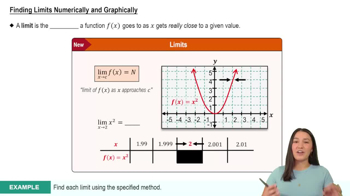
The limit of a function f(x) as x approaches a value c is the value that f(x) gets closer to as x gets closer to c.
Track progress
Control buttons has been changed to "navigation" mode.
1/20
Recommended videos
03:33
Cases Where Limits Do Not Exist Example 2
3180
views
84
rank
6:47
Finding Limits Numerically and Graphically
9688
views
357
rank
3
comments
03:07
Cases Where Limits Do Not Exist
3494
views
81
rank
1
comments
Terms in this set (20)
Hide definitions
What is the definition of a limit in calculus?
The limit of a function f(x) as x approaches a value c is the value that f(x) gets closer to as x gets closer to c.
How is the limit of f(x) as x approaches c written symbolically?
It is written as \(\lim_{x \to c} f(x)\).
What does it mean if \(\lim_{x \to c} f(x) = L\)?
It means as x approaches c, the values of f(x) approach the number L.
What is a one-sided limit?
A one-sided limit considers the value of f(x) as x approaches c from only one side: left (\(x \to c^-\)) or right (\(x \to c^+\)).
When does a limit not exist?
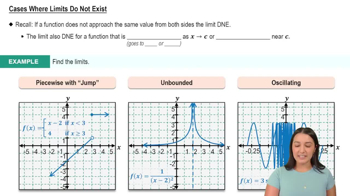
A limit does not exist if the left and right limits are not equal, or if the function grows without bound near c.
What is the limit of a constant function f(x) = k as x approaches any value c?
The limit is k, since the function value is always k.
How do you find the limit of a polynomial function as x approaches c?
Substitute x = c directly into the polynomial to find the limit.
What is the limit of \(\frac{1}{x}\) as x approaches 0 from the right?
The limit is +∞ because values become very large positive numbers.
What is the limit of \(\frac{1}{x}\) as x approaches 0 from the left?
The limit is -∞ because values become very large negative numbers.
What is the Squeeze Theorem?
If f(x) ≤ g(x) ≤ h(x) near c and \(\lim_{x \to c} f(x) = \lim_{x \to c} h(x) = L\), then \(\lim_{x \to c} g(x) = L\).
What is an indeterminate form in limits?
An expression like \(\frac{0}{0}\) or \(\infty - \infty\) that does not directly determine the limit.
How can limits involving indeterminate forms be evaluated?
By algebraic manipulation, factoring, rationalizing, or applying L'Hôpital's Rule if applicable.
What is the limit of \(\sin x / x\) as x approaches 0?
The limit is 1.
What is the limit of \((1 + \frac{1}{n})^n\) as n approaches infinity?
The limit is the mathematical constant e, approximately 2.718.
What does it mean for a function to be continuous at a point c in terms of limits?
f is continuous at c if \(\lim_{x \to c} f(x) = f(c)\).
What is the limit of \(x^2\) as x approaches 3?
The limit is 9, since \(3^2 = 9\).
How do you interpret \(\lim_{x \to \infty} f(x)\)?
It describes the behavior of f(x) as x grows without bound.
What is the limit of \(\frac{1}{x}\) as x approaches infinity?
The limit is 0.
What is the limit of \(\frac{1}{x}\) as x approaches negative infinity?
The limit is 0.
What is the difference between a limit and a function value?
A limit describes the value f(x) approaches near c, while the function value is f(c) itself.
 BackBack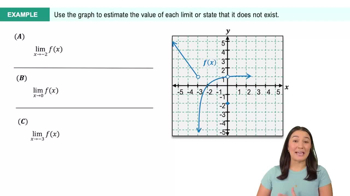
 03:33
03:33