Skip to main content
Calculus
My Course
Learn
Exam Prep
AI Tutor
Study Guides
Textbook Solutions
Flashcards
Explore
Try the app
My Course
Learn
Exam Prep
AI Tutor
Study Guides
Textbook Solutions
Flashcards
Explore
Try the app
Back
Techniques of Integration and Applications in Calculus
You can tap to flip the card.
What is the LIATE rule used for in integration by parts?
You can tap to flip the card.
👆
What is the LIATE rule used for in integration by parts?
LIATE helps choose u in integration by parts: Logarithmic, Inverse trig, Algebraic, Trigonometric, Exponential, in that order of priority.
Track progress
Control buttons has been changed to "navigation" mode.
1/20
Recommended videos
05:23
Finding Area Between Curves on a Given Interval
1440
views
43
rank
05:06
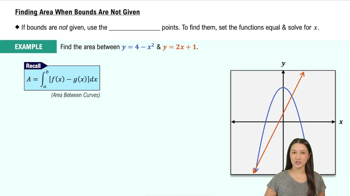
Finding Area When Bounds Are Not Given
698
views
14
rank
06:21
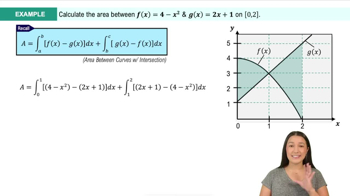
Finding Area Between Curves that Cross on the Interval Example 2
473
views
6
rank
Terms in this set (20)
Hide definitions
What is the LIATE rule used for in integration by parts?
LIATE helps choose u in integration by parts: Logarithmic, Inverse trig, Algebraic, Trigonometric, Exponential, in that order of priority.
How do you complete the square for a quadratic expression ax^2 + bx + c?
Rewrite as a(x + b/(2a))^2 + (c - b^2/(4a)) to simplify integration involving quadratics.
What substitution is used in trigonometric substitution for integrals involving sqrt(a^2 - x^2)?
Use x = a sin θ, with θ in [-π/2, π/2], to simplify the integral.
State the product-to-sum identity for ∫ sin(mx) cos(nx) dx.
sin A cos B = 1/2 [sin(A - B) + sin(A + B)].
What is the formula for integration by parts?
∫ u dv = uv - ∫ v du.
How do you integrate powers of sine and cosine when one power is odd?
Express the odd power as (sin^2 x)^k sin x or (cos^2 x)^k cos x, use Pythagorean identity, and substitute u = cos x or sin x.
What is the trapezoidal rule formula for approximating ∫_a^b f(x) dx?
T = (Δx/2) [f(x_0) + 2f(x_1) + 2f(x_2) + ... + 2f(x_{n-1}) + f(x_n)].
How is Simpson's rule expressed for approximating ∫_a^b f(x) dx?
S = (Δx/3) [f(x_0) + 4f(x_1) + 2f(x_2) + 4f(x_3) + ... + 4f(x_{n-1}) + f(x_n)], with n even.
What is the error bound for the trapezoidal rule?
|E_T| ≤ (M(b - a)^3) / (12 n^2), where M bounds |f''(x)| on [a,b].
What is the error bound for Simpson's rule?
|E_S| ≤ (M(b - a)^5) / (180 n^4), where M bounds |f^{(4)}(x)| on [a,b].
How do you determine if an improper integral of Type I converges?
Evaluate the limit of the integral as the bound approaches infinity; if the limit exists and is finite, it converges.
What is the difference between Type I and Type II improper integrals?
Type I has infinite limits of integration; Type II has discontinuities (vertical asymptotes) within the interval.
How do you handle an improper integral with a vertical asymptote inside the interval?
Split the integral at the discontinuity and take limits approaching the asymptote from each side.
What is the general form for partial fraction decomposition with distinct linear factors?
Express as sum of A_i / (a_i x + b_i) for each linear factor.
How do you decompose a rational function with repeated linear factors?
Include terms for each power up to the multiplicity: A_1/(x-r) + A_2/(x-r)^2 + ... + A_r/(x-r)^r.
How do you decompose a rational function with irreducible quadratic factors?
Use terms of the form (Ax + B) / (quadratic factor).
What is the substitution for integrals involving sqrt(x^2 - a^2)?
Use x = a sec θ.
What is the substitution for integrals involving sqrt(a^2 + x^2)?
Use x = a tan θ.
How do you find the average value of a function f on [a,b]?
Average value = (1/(b - a)) ∫_a^b f(x) dx.
What is the formula for the volume of a solid of revolution about the y-axis using the shell method?
V = 2π ∫_a^b (radius)(height) dx.
 BackBack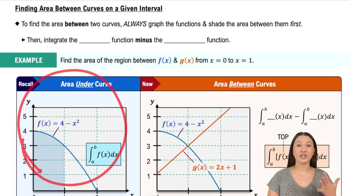
 05:23
05:23