Pearson+ LogoPearson+ Logo

Breakdown and Utilization of Sugars and Fats quiz #1 Flashcards

Back
Breakdown and Utilization of Sugars and Fats quiz #1
Control buttons has been changed to "navigation" mode.
1/10
  • Which cellular process breaks down sugar molecules to supply energy to the cell, and what is the main energy-carrying molecule produced?

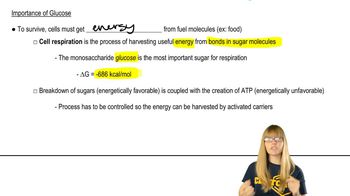
    Cellular respiration is the process that breaks down sugar molecules, such as glucose, to supply energy to the cell. The main energy-carrying molecule produced during this process is ATP (adenosine triphosphate).
  • What is the difference between catabolism and anabolism in cellular metabolism?

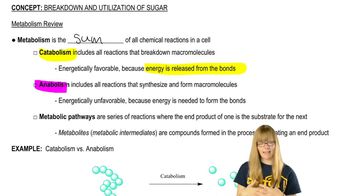
    Catabolism involves breaking down macromolecules and releases energy, while anabolism synthesizes macromolecules and consumes energy. These processes are fundamental to cellular metabolism.
  • What are metabolites in the context of metabolic pathways?

    Metabolites are intermediate compounds formed during the sequential reactions of metabolic pathways. They serve as substrates or products in the process of creating an end product.
  • Why must the breakdown of glucose in cellular respiration be a controlled process?

    The breakdown of glucose is controlled to harvest energy in small steps, preventing the release of excessive energy that could damage cellular components. This allows efficient transfer of energy to molecules like ATP.
  • Where does glycolysis occur within the cell, and what are its main products?

    Glycolysis occurs in the cytosol of the cell. Its main products are ATP, NADH, and pyruvate.
  • What role do lysosomes play in the digestion stage of catabolism?

    Lysosomes act as the cell's stomach, breaking down large molecules into smaller subunits during digestion. This process can occur inside the cell if the molecules enter the lysosome.
  • What is the fate of pyruvate in cells when oxygen is not available?

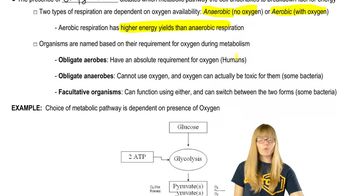
    When oxygen is absent, pyruvate undergoes fermentation instead of entering aerobic pathways. Fermentation produces less energy compared to aerobic respiration.
  • How are organisms classified based on their oxygen requirements for metabolism?

    Organisms are classified as obligate aerobes, obligate anaerobes, or facultative organisms based on their need for oxygen. Obligate aerobes require oxygen, obligate anaerobes find oxygen toxic, and facultative organisms can switch between aerobic and anaerobic metabolism.
  • What is oxidative phosphorylation and where does it occur in the cell?

    Oxidative phosphorylation is a metabolic pathway that produces the largest amount of ATP and consumes oxygen. It occurs in the mitochondria.
  • Why do animal cells prefer aerobic respiration over anaerobic respiration?

    Animal cells prefer aerobic respiration because it yields much more energy than anaerobic respiration. However, aerobic respiration can only occur when oxygen is available.