Pearson+ LogoPearson+ Logo

Cell Culture quiz #1 Flashcards

Back
Cell Culture quiz #1
Control buttons has been changed to "navigation" mode.
1/10
  • What is a viable cell count in the context of cell culture?

    A viable cell count refers to the measurement of the number of living cells in a culture, indicating how many cells are alive and capable of growth and division under the given culture conditions.
  • What essential functions does a culture medium provide to living cells in cell culture?

    A culture medium provides living cells with necessary nutrients, maintains appropriate temperature, and facilitates gas exchange, all of which are required for cell survival, growth, and division in a laboratory setting.
  • What is the main difference between primary and secondary cell cultures?

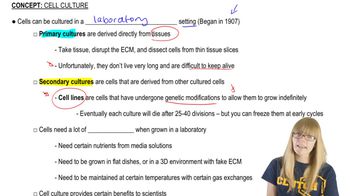
    Primary cultures are derived directly from tissue, while secondary cultures originate from previously cultured cells. Secondary cultures are generally easier to maintain and can be used to create cell lines.
  • Why are primary cultures considered difficult to maintain in the laboratory?

    Primary cultures are difficult to maintain because the extraction process is harsh and the cells do not survive long outside their natural environment. They are more sensitive and have a shorter lifespan compared to cell lines.
  • How are cell lines typically preserved for long-term use?

    Cell lines are frozen at extremely low temperatures, such as minus 80°C or in liquid nitrogen. This allows them to be stored for years and revived when needed.
  • What is a common source of cell lines that can divide indefinitely?

    Cell lines that divide indefinitely are often derived from cancer cells or genetically modified cells. These cells have mutations that allow for continuous growth and division.
  • Why is cell culture considered convenient for experimental research?

    Cell culture is convenient because large numbers of cells can be grown in a single dish, eliminating the need for many individual organisms. This makes experiments easier and more scalable.
  • What is the typical appearance of cultured cells under a microscope without staining?

    Cultured cells appear transparent under a microscope unless they are stained. Their internal structures are difficult to distinguish without specific dyes.
  • What term is commonly used to describe research performed using cell culture, and why is there confusion about it?

    Research using cell culture is commonly called in vitro research because it occurs outside a living organism. Some biochemists may refer to it as in vivo since the cells are alive, leading to confusion.
  • What environmental conditions must be controlled when growing cells in culture?

    Cells in culture require controlled temperature, nutrient supply, and gas exchange to mimic their natural environment. These conditions are essential for cell survival and growth.