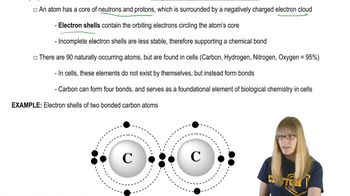
What is the overall charge of the nucleus of an atom, and which subatomic particles contribute to this charge?
The nucleus of an atom has a positive charge, which is contributed by protons. Neutrons are also present in the nucleus but have no charge.
What determines the stability of an atom's electron shells and drives the formation of chemical bonds?
Electron shells seek a specific number of electrons to be stable. Atoms form chemical bonds to achieve this stable configuration.
Which four atoms are most commonly involved in chemical bonds within cells?
Carbon, hydrogen, nitrogen, and oxygen are the primary atoms involved in cellular chemical bonds. They make up about 95% of cellular chemistry.
How many covalent bonds can a carbon atom typically form, and why is this significant in cell biology?
A carbon atom can form four covalent bonds. This property makes carbon a foundational element in biological chemistry.
What is electronegativity, and how does it affect the polarity of molecules like water?
Electronegativity is an atom's ability to attract electrons. In water, oxygen's higher electronegativity causes unequal electron sharing, resulting in a polar molecule.
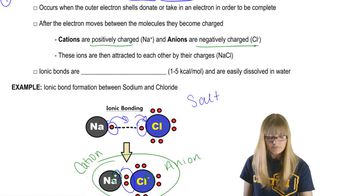
How do ionic bonds form between atoms such as sodium and chloride?
Ionic bonds form when one atom donates an electron and another atom accepts it, creating charged ions. These oppositely charged ions are then attracted to each other.
What is the difference in bond strength between covalent and non-covalent bonds in cell biology?
Covalent bonds are much stronger, requiring more energy to break, such as 84 kilocalories per mole for a carbon-oxygen bond. Non-covalent bonds like ionic, hydrogen, and van der Waals are much weaker, typically 1–5 kilocalories per mole.
Why do hydrophobic molecules aggregate in water, and what is this phenomenon called?
Hydrophobic molecules aggregate in water because they cannot form hydrogen bonds and are excluded by water molecules. This phenomenon is called the hydrophobic effect.
How do van der Waals attractions contribute to molecular interactions, and what is a real-life example?
Van der Waals attractions are weak, nonspecific forces that increase as atoms approach each other. A real-life example is the sticky feet of geckos, which use these forces to adhere to surfaces.
What is molecular complementarity, and how does it influence binding affinity between molecules?
Molecular complementarity refers to the perfect fit between two molecules, like a lock and key. The better the fit, the higher the binding affinity due to more bonds formed.
 Back
Back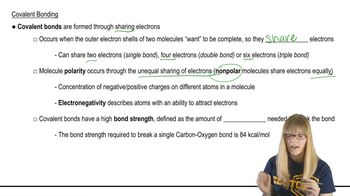
 03:09
03:09