Pearson+ LogoPearson+ Logo

Chloroplast quiz #1 Flashcards

Back
Chloroplast quiz #1
Control buttons has been changed to "navigation" mode.
1/40
  • What is the primary function of the chloroplast in plant cells, and where within the chloroplast does this function mainly occur?

    The primary function of the chloroplast is to carry out photosynthesis, converting light energy into chemical energy. This process mainly occurs in the thylakoids, which are membrane-bound discs inside the chloroplast.
  • Describe the structural organization of a chloroplast, including its membranes and internal components.

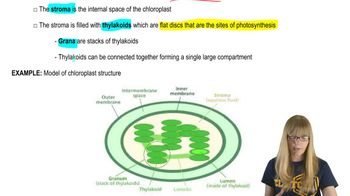
    A chloroplast has a double membrane structure with an outer membrane, inner membrane, and an intermembrane space. Inside, the stroma contains thylakoids (flat discs) organized into stacks called grana, where photosynthesis takes place.
  • From what precursor do chloroplasts originate, and what other organelles can develop from this precursor?

    Chloroplasts originate from proplastids, which are undifferentiated organelles in plant cells. Other organelles that can develop from proplastids include chromoplasts (containing pigments) and amyloplasts (storing starch).
  • To which family of plant organelles do chloroplasts belong, and what is a key characteristic of this family?

    Chloroplasts belong to the plastid family of plant organelles. A key characteristic of plastids is that they all originate from proplastids and can differentiate into various types, such as chloroplasts, chromoplasts, and amyloplasts.
  • What is the main function of the chloroplast in plant cells, and in which internal structure does this function primarily take place?

    The main function of the chloroplast is to perform photosynthesis, converting light energy into chemical energy. This primarily occurs in the thylakoids inside the chloroplast.
  • Describe the membrane structure of a chloroplast and name its main internal components.

    A chloroplast has a double membrane with an outer membrane, inner membrane, and an intermembrane space. Inside, it contains the stroma and thylakoids, which are organized into stacks called grana.
  • What are thylakoids and grana, and how are they related within the chloroplast?

    Thylakoids are flat, disc-shaped structures where photosynthesis occurs. Grana are stacks of thylakoids within the chloroplast.
  • From what precursor organelle do chloroplasts develop, and what other organelles can arise from this precursor?

    Chloroplasts develop from proplastids, which are undifferentiated organelles in plant cells. Other organelles that can arise from proplastids include chromoplasts and amyloplasts.
  • To which family of plant organelles do chloroplasts belong, and what is a defining feature of this family?

    Chloroplasts belong to the plastid family of plant organelles. A defining feature of plastids is that they all originate from proplastids and can differentiate into various types.
  • How are thylakoids within a chloroplast connected, and what is the significance of this arrangement?

    Thylakoids can be connected together to form a single large compartment within the chloroplast. This arrangement facilitates efficient photosynthesis by allowing the movement of molecules and energy between thylakoids.
  • What two types of cells contain chloroplasts?

    Chloroplasts are found in plant cells and some algal cells.
  • Chloroplasts convert energy from the sun into what form?

    Chloroplasts convert energy from the sun into chemical energy through photosynthesis.
  • Which organelle is responsible for photosynthesis in plant cells?

    The chloroplast is responsible for photosynthesis in plant cells.
  • What is the main function of the chloroplast?

    The main function of the chloroplast is to carry out photosynthesis, converting light energy into chemical energy.
  • Where in the plant cell does photosynthesis take place?

    Photosynthesis takes place in the chloroplast of plant cells.
  • What is the interior space of the chloroplast called?

    The interior space of the chloroplast is called the stroma.
  • Where is chlorophyll found within the chloroplast?

    Chlorophyll is found in the thylakoid membranes within the chloroplast.
  • What are chloroplasts and where are they found?

    Chloroplasts are organelles responsible for photosynthesis and are found in plant cells and some algae.
  • Which organelle contains chlorophyll?

    The chloroplast contains chlorophyll.
  • What is the role of the chloroplast in plant cells?

    The chloroplast's role is to perform photosynthesis, converting solar energy into chemical energy.
  • What is the stroma in a chloroplast?

    The stroma is the internal fluid-filled space of the chloroplast where the thylakoids are located.
  • What are thylakoids in the chloroplast?

    Thylakoids are flat, disc-shaped structures inside the chloroplast where photosynthesis occurs.
  • What are grana in chloroplasts?

    Grana are stacks of thylakoids within the chloroplast.
  • What is the primary pigment found in the chloroplast?

    The primary pigment found in the chloroplast is chlorophyll.
  • How many membranes surround a chloroplast?

    A chloroplast is surrounded by two membranes: an outer membrane and an inner membrane.
  • What family of organelles do chloroplasts belong to?

    Chloroplasts belong to the plastid family of organelles.
  • From what precursor do all plastids, including chloroplasts, originate?

    All plastids, including chloroplasts, originate from proplastids.
  • What is the function of the thylakoid in the chloroplast?

    The thylakoid is the site of the light-dependent reactions of photosynthesis.
  • What is the function of grana in the chloroplast?

    Grana increase the surface area for light-dependent reactions of photosynthesis.
  • What is the function of the stroma in the chloroplast?

    The stroma contains enzymes and molecules necessary for the light-independent reactions of photosynthesis.
  • What type of cells contain chloroplasts?

    Plant cells and some algal cells contain chloroplasts.
  • Which organelle is only found in plant cells and some algae?

    The chloroplast is only found in plant cells and some algae.
  • What is the main function of chlorophyll in the chloroplast?

    Chlorophyll absorbs light energy for use in photosynthesis.
  • What would happen if chloroplasts stopped working in a plant cell?

    If chloroplasts stopped working, the plant would be unable to perform photosynthesis and would not produce the energy it needs to survive.
  • What are the two main functions of chloroplasts?

    The two main functions of chloroplasts are to perform photosynthesis and to synthesize carbohydrates.
  • What organelle makes carbohydrates in plant cells?

    The chloroplast makes carbohydrates during photosynthesis.
  • What is an analogy for the chloroplast in a plant cell?

    The chloroplast is like a solar panel, capturing sunlight and converting it into usable energy.
  • Why don't animal cells need chloroplasts?

    Animal cells do not perform photosynthesis and obtain energy from consuming other organisms, so they do not need chloroplasts.
  • Are chloroplasts found in most plant cells?

    Yes, chloroplasts are found in most plant cells.
  • How does chlorophyll help the functioning of chloroplasts?

    Chlorophyll absorbs light energy, which is essential for the process of photosynthesis in chloroplasts.