Skip to main content
Cell Biology
My Course
Learn
Exam Prep
AI Tutor
Study Guides
Flashcards
Explore
Try the app
My Course
Learn
Exam Prep
AI Tutor
Study Guides
Flashcards
Explore
Try the app
Back
Chloroplast quiz #3
You can tap to flip the card.
Which organelle does photosynthesis occur?
You can tap to flip the card.
👆
Which organelle does photosynthesis occur?
Photosynthesis occurs in the chloroplast.
Track progress
Control buttons has been changed to "navigation" mode.
1/40
Related flashcards
Related practice
Recommended videos
Chloroplast quiz #1
Chloroplast
40 Terms
Chloroplast quiz #2
Chloroplast
40 Terms
Chloroplast quiz #4
Chloroplast
10 Terms
Chloroplast
12. Photosynthesis
7 problems
Topic
Light Dependent Reactions
12. Photosynthesis
7 problems
Topic
12. Photosynthesis
4 topics
12 problems
Chapter
Guided course
03:11
Chloroplast
665
views
1
rank
Terms in this set (40)
Hide definitions
Which organelle does photosynthesis occur?
Photosynthesis occurs in the chloroplast.
Which organelle does photosynthesis?
The chloroplast performs photosynthesis.
Which organelle performs photosynthesis?
The chloroplast performs photosynthesis.
Which organelle performs photosynthesis?
The chloroplast performs photosynthesis.
Which organelle is responsible for photosynthesis?
The chloroplast is responsible for photosynthesis.
Which part of the plant cell performs photosynthesis?
The chloroplast performs photosynthesis in the plant cell.
Where is chlorophyll found in a plant cell?
Chlorophyll is found in the thylakoid membranes of the chloroplast in a plant cell.
Where is chlorophyll found in the chloroplast?
Chlorophyll is found in the thylakoid membranes of the chloroplast.
Where in the chloroplast is chlorophyll found?
Chlorophyll is found in the thylakoid membranes within the chloroplast.
What is the function of chloroplasts in plant cells?
The function of chloroplasts in plant cells is to perform photosynthesis.
What is the function of the chloroplast in a plant cell?
The function of the chloroplast in a plant cell is to convert light energy into chemical energy through photosynthesis.
What is the function of the chloroplast?
The function of the chloroplast is to carry out photosynthesis.
What is the function of the chloroplasts?
The function of the chloroplasts is to perform photosynthesis.
What is the function of a chloroplast?
The function of a chloroplast is to perform photosynthesis.
What is the function of the thylakoid membrane in the chloroplast?
The thylakoid membrane contains chlorophyll and is the site of the light-dependent reactions of photosynthesis.
What is the main function of the stroma in the chloroplast?
The stroma is the site of the light-independent reactions (Calvin cycle) of photosynthesis.
What is the main function of grana in the chloroplast?
Grana increase the surface area for light absorption during photosynthesis.
What is the main function of the outer and inner membranes of the chloroplast?
The outer and inner membranes of the chloroplast protect the organelle and regulate the movement of substances in and out.
What is the intermembrane space in the chloroplast?
The intermembrane space is the region between the outer and inner membranes of the chloroplast.
What is a proplastid?
A proplastid is an undifferentiated precursor organelle from which all plastids, including chloroplasts, originate.
What are chromoplasts?
Chromoplasts are plastids that contain pigments other than chlorophyll and are involved in pigment synthesis and storage.
What are amyloplasts?
Amyloplasts are plastids that store starch in plant cells.
What is the relationship between proplastids and chloroplasts?
Chloroplasts develop from proplastids, which are undifferentiated plastid precursors.
What is the main difference between chloroplasts and other plastids?
Chloroplasts perform photosynthesis, while other plastids have different functions such as pigment storage or starch storage.
What is the main energy conversion process that occurs in the chloroplast?
The main energy conversion process in the chloroplast is photosynthesis, which converts light energy into chemical energy.
What is the main structural feature of the chloroplast that distinguishes it from other organelles?
The chloroplast has a double membrane and contains thylakoids organized into grana.
What is the main function of the plastid family of organelles?
The plastid family of organelles is involved in various biosynthetic and storage functions, with chloroplasts specializing in photosynthesis.
What is the main function of the outer membrane of the chloroplast?
The outer membrane of the chloroplast serves as a protective barrier and regulates the entry and exit of materials.
What is the main function of the inner membrane of the chloroplast?
The inner membrane of the chloroplast regulates the passage of materials into and out of the stroma.
What is the main function of the intermembrane space in the chloroplast?
The intermembrane space separates the outer and inner membranes and plays a role in transport and compartmentalization.
What is the main function of the thylakoid lumen?
The thylakoid lumen is involved in the light-dependent reactions of photosynthesis, including the generation of a proton gradient.
What is the main function of the granum in the chloroplast?
The granum increases the surface area for light absorption and the efficiency of photosynthesis.
What is the main function of the stroma in the chloroplast?
The stroma contains enzymes for the Calvin cycle and other biosynthetic processes.
What is the main function of chlorophyll in the chloroplast?
Chlorophyll captures light energy for use in photosynthesis.
What is the main function of the chloroplast in plant cells?
The main function of the chloroplast in plant cells is to perform photosynthesis.
What is the main function of the chloroplast in algae?
The main function of the chloroplast in algae is to perform photosynthesis.
What is the main function of the chloroplast in photosynthetic eukaryotes?
The main function of the chloroplast in photosynthetic eukaryotes is to convert light energy into chemical energy through photosynthesis.
What is the main function of the chloroplast in energy conversion?
The chloroplast converts solar energy into chemical energy stored in carbohydrates.
What is the main function of the chloroplast in carbohydrate synthesis?
The chloroplast synthesizes carbohydrates during photosynthesis.
What is the main function of the chloroplast in plant metabolism?
The chloroplast is central to plant metabolism by providing energy and organic molecules through photosynthesis.
 BackBack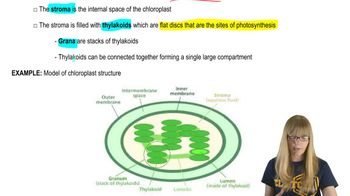
 03:11
03:11