What is the term for cell death caused by poor blood flow?
Cell death caused by poor blood flow is called necrosis.
What is the scientific term for programmed cell death?
Programmed cell death is known as apoptosis.
What cellular structure is degraded during apoptosis to prevent the release of harmful enzymes into the body?
The plasma membrane is compartmentalized into apoptotic bodies during apoptosis. This prevents the release of harmful lysosomal enzymes into the extracellular matrix.
What is the role of pro-caspases in the process of apoptosis?
Pro-caspases are inactive precursors of caspases that must be cleaved to become active. Once activated, they initiate the cascade leading to cellular breakdown.
Which proteins inhibit apoptosis by preventing cytochrome c release from mitochondria?
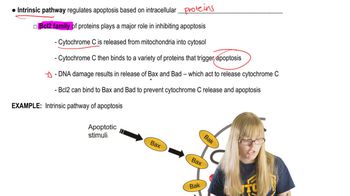
The Bcl-2 family of proteins inhibits apoptosis by binding to Bax and Bad, preventing cytochrome c release. This blocks the intrinsic pathway of apoptosis.
What triggers the intrinsic pathway of apoptosis in response to DNA damage?
DNA damage activates Bax and Bad proteins, which promote the release of cytochrome c from mitochondria. This release initiates the intrinsic pathway of apoptosis.
How does the extrinsic pathway of apoptosis begin at the cell surface?
The extrinsic pathway begins when death receptors on the plasma membrane bind to specific ligands, such as the FAS ligand. This binding forms the death-inducing signaling complex, triggering apoptosis.
What is the function of executioner caspases during apoptosis?
Executioner caspases break down cellular components, leading to cell dismantling. They are activated by initiator caspases in the apoptotic cascade.
How do survival factors suppress apoptosis in cells?
Survival factors inhibit the activity of Bad and regulate the Bcl-2 family, preventing the initiation of apoptosis. This helps maintain cell survival when death is not required.
 Back
Back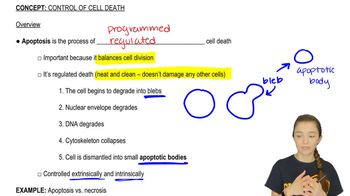
 14:19
14:19