What is the term used to describe the process when a cell increases in size?
The process when a cell increases in size is called cell growth.
What factor limits the size of a cell?
The size of a cell is limited by its ability to efficiently exchange materials with its environment, which is influenced by the surface area-to-volume ratio.
What are the main factors that limit the maximum size a cell can reach?
The maximum size of a cell is limited by the surface area-to-volume ratio, which affects the cell's ability to transport nutrients and waste efficiently, as well as by regulatory mechanisms involving mitogens, growth factors, and survival factors.
How do extracellular factors such as mitogens, growth factors, and survival factors influence cell size?
Mitogens stimulate cell division by removing cell cycle inhibitors, growth factors promote cell growth by enhancing protein synthesis and inhibiting degradation, and survival factors suppress apoptosis to enhance cell survival, all contributing to the regulation of cell size.
What is the role of G1 CDKs in cell cycle progression?
G1 CDKs are activated by mitogens and help the cell enter the growth phase of the cell cycle. Without G1 CDKs, cells remain in the G0 phase and do not grow or divide.
How do growth factors stimulate cell growth at the molecular level?
Growth factors bind to receptors on the plasma membrane and activate intracellular proteins that promote protein synthesis and inhibit protein degradation. This leads to increased cell size by accumulating more proteins and organelles.
What is the function of the E2F transcription factor in the cell cycle?
E2F transcription factor promotes entry into the S phase by activating genes necessary for DNA synthesis. Its activity is regulated by mitogens, growth factors, and the retinoblastoma protein.
What happens to cell cycle regulation if the retinoblastoma (RB) protein is mutated?
If the RB protein is mutated, it cannot inhibit E2F, allowing uncontrolled cell cycle progression and cell division. This loss of regulation is commonly associated with cancer development.
Which signaling pathway is involved in supporting cell growth and DNA damage repair?
The PI3KAKT pathway is involved in supporting cell growth and DNA damage repair. It can pause the cell cycle to allow for DNA repair while promoting cell growth.
How does the RAS MAPK signaling pathway contribute to cell growth?
The RAS MAPK pathway activates transcription factors that support cell growth. It is one of several pathways that regulate cell size and division.
 Back
Back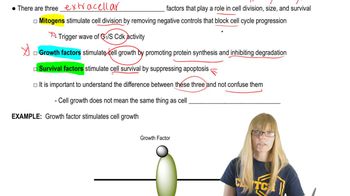
 07:26
07:26