Pearson+ LogoPearson+ Logo

Control of the Cell Cycle quiz #1 Flashcards

Back
Control of the Cell Cycle quiz #1
Control buttons has been changed to "navigation" mode.
1/28
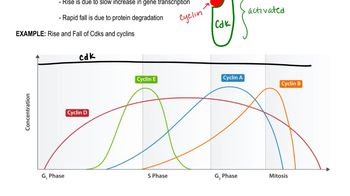
  • What roles do cyclins and cyclin-dependent kinases (CDKs) play in controlling the cell cycle, and how do their concentrations differ throughout the cycle?

    Cyclins are proteins that regulate the cell cycle by binding to and activating cyclin-dependent kinases (CDKs), which then phosphorylate target proteins to control cell cycle events. Cyclin concentrations fluctuate at different stages of the cell cycle, peaking at specific phases to regulate transitions, while CDK concentrations remain constant but are only active when bound to cyclins.
  • What are the main checkpoints in the cell cycle, and what does each checkpoint monitor before allowing the cell to proceed?

    The main checkpoints are the G1 checkpoint (checks cell size, nutrients, growth factors, and DNA damage), the S checkpoint (ensures DNA replication is complete and accurate), the G2 checkpoint (verifies DNA replication and repairs any damage before mitosis), and the M checkpoint (spindle checkpoint, ensures chromosomes are properly attached to spindle fibers before separation).
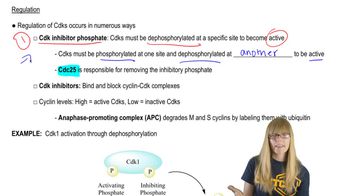
  • Describe three mechanisms by which cyclin-dependent kinase (CDK) activity is regulated during the cell cycle.

    CDK activity is regulated by: (1) inhibitory phosphorylation, where a specific phosphate must be removed by cdc25 to activate the CDK; (2) binding of CDK inhibitors, which block CDK function; and (3) regulation of cyclin levels, where cyclins are degraded (e.g., by the anaphase promoting complex) when no longer needed, thus inactivating CDKs.
  • What is the primary function of cyclins in the cell cycle?

    Cyclins regulate the cell cycle by binding to and activating cyclin-dependent kinases (CDKs), which then phosphorylate target proteins to control cell cycle events.
  • How do the concentrations of cyclins and CDKs differ throughout the cell cycle?

    Cyclin concentrations fluctuate and peak at specific phases to regulate transitions, while CDK concentrations remain constant but are only active when bound to cyclins.
  • What does the G1 checkpoint monitor before allowing the cell to proceed to S phase?

    The G1 checkpoint checks for cell size, nutrient availability, growth factors, and DNA damage before allowing the cell to proceed.
  • What is the main role of the S checkpoint in the cell cycle?

    The S checkpoint ensures that DNA replication is complete and accurate before the cell continues to the next phase.
  • Describe one mechanism by which CDK activity is inhibited during the cell cycle.

    CDK activity can be inhibited by the addition of an inhibitory phosphate, which must be removed by the cdc25 protein for activation.
  • How does the anaphase promoting complex (APC) regulate cyclin levels?

    The APC labels cyclins with ubiquitin for degradation, especially M and S cyclins, thus inactivating CDKs when cyclins are no longer needed.
  • What is the function of CDK inhibitors in cell cycle regulation?

    CDK inhibitors are proteins that bind to CDKs (often in complex with cyclins) and block their function, preventing progression through the cell cycle.
  • How do cyclin-dependent kinases (CDKs) promote cell division?

    CDKs promote cell division by phosphorylating or dephosphorylating target proteins, which activates or inactivates processes necessary for cell cycle progression. CDKs are activated when bound to specific cyclins, allowing them to regulate events such as DNA replication and mitosis.
  • What does the G2 checkpoint ensure before the cell cycle can continue?

    The G2 checkpoint ensures that DNA has been completely replicated, any DNA damage or mutations have been repaired, and the cell is ready for mitosis before the cell cycle can continue.
  • What is the role of cyclins in the cell cycle?

    Cyclins regulate the timing of cell cycle events by binding to and activating CDKs. Their concentrations vary throughout the cell cycle, controlling progression through different phases and checkpoints.
  • When are CDKs present during the cell cycle?

    CDKs are present at constant levels throughout the entire cell cycle; their activity depends on the availability of cyclins.
  • What controls the cell cycle at key checkpoints?

    The cell cycle is controlled at key checkpoints by the activity of cyclins and CDKs, which assess conditions such as cell size, nutrient availability, and DNA integrity.
  • What are proteins that stimulate cell division?

    Proteins that stimulate cell division include cyclins, which activate CDKs, and growth factors, which signal cells to enter the cell cycle.
  • What are growth factors in the context of the cell cycle?

    Growth factors are external signaling proteins that stimulate cells to enter the cell cycle and divide by promoting progression through checkpoints.
  • What is MPF (Maturation Promoting Factor) in the cell cycle?

    MPF is a complex of M cyclin and CDK that triggers the onset of mitosis by phosphorylating proteins required for mitosis.
  • What is the G0 phase in the cell cycle?

    The G0 phase is a resting or non-dividing state where cells exit the cell cycle and do not actively prepare for division.
  • How do CDKs promote cell division?

    CDKs promote cell division by phosphorylating proteins involved in cell cycle progression, but only when activated by binding to specific cyclins.
  • How many major checkpoints are there in the cell cycle?

    There are four major checkpoints in the cell cycle: G1, S, G2, and M (spindle checkpoint).
  • What is the purpose of checkpoints in the cell cycle?

    Checkpoints ensure that conditions are suitable for cell division, such as proper cell size, sufficient nutrients, and intact, fully replicated DNA, preventing errors and uncontrolled division.
  • What is the role of checkpoints in the cell cycle?

    Checkpoints monitor and verify that critical processes like DNA replication and repair are complete and accurate before allowing the cell to proceed to the next phase.
  • What happens in the G2 phase of the cell cycle?

    During the G2 phase, the cell prepares for mitosis by repairing any DNA damage, ensuring DNA replication is complete, and making final preparations for cell division.
  • What occurs during the G2 phase of the cell cycle?

    In the G2 phase, the cell checks for DNA damage, repairs mutations, and ensures all DNA has been replicated before entering mitosis.
  • What is the purpose of cell cycle checkpoints?

    The purpose of cell cycle checkpoints is to ensure that the cell only progresses to the next phase when conditions are optimal and all necessary processes, such as DNA replication and repair, are complete.
  • How do external regulators respond to events outside the cell?

    External regulators, such as growth factors, respond to events outside the cell by signaling the cell to enter or progress through the cell cycle, often in response to environmental cues or tissue needs.
  • What controls the cell cycle at key checkpoints?

    Cyclins and CDKs control the cell cycle at key checkpoints by regulating the activation of proteins necessary for progression through each phase.