What is cytokinesis and when does it occur during the cell cycle?
Cytokinesis is the final step of cell division, occurring after anaphase, where the cytoplasm divides to form two separate daughter cells.
How does the mitotic spindle contribute to cytokinesis?
The mitotic spindle helps position the cleavage furrow, ensuring the cell divides in the correct location so each daughter cell receives half of the organelles and chromosomes.
What is the cleavage furrow and why is its positioning important?
The cleavage furrow is the indentation where the cell will split during cytokinesis. Its correct positioning is crucial to ensure equal distribution of cellular contents between daughter cells.
What is the contractile ring and what is it made of?
The contractile ring is a structure composed of actin and myosin that forms during anaphase and generates the force needed to separate the two daughter cells.
What role does the protein Rho A play in cytokinesis?
Rho A is a GTPase that triggers the formation of the contractile ring, which is essential for cytokinesis.
Why is cytokinesis usually symmetrical, and when might it be asymmetrical?
Cytokinesis is usually symmetrical to ensure both daughter cells receive equal amounts of organelles and chromosomes, but it can be asymmetrical if one cell needs more of certain organelles, such as mitochondria.
How does cytokinesis differ between animal and plant cells?
In animal cells, cytokinesis involves the contractile ring and cleavage furrow, while in plant cells, it involves forming a new cell wall using the phragmoplast and cell plate.
What is the phragmoplast and what is its function in plant cell cytokinesis?
The phragmoplast is a structure made of microtubules that helps assemble the cell plate, which is the precursor to the new cell wall in plant cells.
What is the cell plate and how does it relate to the new cell wall in plant cells?
The cell plate is a precursor structure formed during plant cell cytokinesis that eventually develops into the new cell wall separating the two daughter cells.
Why is the correct positioning of the cleavage furrow critical during cytokinesis?
Correct positioning ensures that each daughter cell receives the proper amount of chromosomes and organelles, preventing loss or duplication of cellular components.
What would happen if the cleavage furrow formed in the wrong location?
If the cleavage furrow formed in the wrong location, one or both daughter cells might lack essential organelles or chromosomes, leading to nonviable or abnormal cells.
At what stage does the contractile ring begin to form during cell division?
The contractile ring begins to form during anaphase.
What cellular components are divided between daughter cells during cytokinesis?
Both the replicated chromosomes and organelles are divided between the daughter cells during cytokinesis.
How do microtubules contribute to plant cell cytokinesis?
Microtubules form the phragmoplast, which guides the assembly of the cell plate during plant cell cytokinesis.
What is the main difference in the mechanism of cytokinesis between animal and plant cells?
Animal cells use a contractile ring to pinch the cell in two, while plant cells build a new cell wall (cell plate) between the daughter cells.
What is the significance of symmetrical versus asymmetrical cytokinesis in development?
Symmetrical cytokinesis ensures equal distribution of cellular contents, while asymmetrical cytokinesis can produce cells with different sizes or organelle content, important for specialized cell functions.
Which cytoskeletal proteins are involved in the formation of the contractile ring?
Actin and myosin are the cytoskeletal proteins involved in forming the contractile ring.
What triggers the assembly of the contractile ring during cytokinesis?
The GTPase Rho A triggers the assembly of the contractile ring.
Why do plant cells require the formation of a cell plate during cytokinesis?
Plant cells require a cell plate because they have a rigid cell wall, so a new wall must be constructed between the daughter cells after division.
Is cytokinesis considered part of mitosis?
No, cytokinesis is not part of mitosis; it occurs after mitosis to divide the cytoplasm and complete cell division.
During which stage of the cell cycle does cytokinesis begin?
Cytokinesis begins during anaphase and continues after telophase, following the end of mitosis.
Why is cytokinesis not classified as part of mitosis?
Cytokinesis is not part of mitosis because mitosis refers specifically to the division of the nucleus, while cytokinesis divides the cytoplasm and completes cell division.
What process concludes both mitosis and meiosis?
Both mitosis and meiosis end with cytokinesis, which divides the cytoplasm to form separate daughter cells.
How does a plant cell accomplish cytokinesis?
A plant cell accomplishes cytokinesis by forming a cell plate through the action of the phragmoplast, which eventually develops into a new cell wall between the daughter cells.
What is the end result of mitosis and cytokinesis?
The end result of mitosis and cytokinesis is the formation of two separate daughter cells, each with a complete set of chromosomes and organelles.
How do daughter cells physically separate after mitosis?
Daughter cells separate after mitosis through cytokinesis, where the contractile ring (in animal cells) or cell plate (in plant cells) divides the cytoplasm.
During which phase of the cell cycle does cell division occur?
Cell division occurs during the M phase, which includes both mitosis and cytokinesis.
When do the cytoplasm and cell membrane divide during the cell cycle?
The cytoplasm and cell membrane divide during cytokinesis, which follows mitosis.
Cytokinesis overlaps with which phase of mitosis?
Cytokinesis overlaps with telophase, the final phase of mitosis.
What is a cell plate in plant cell division?
A cell plate is a structure formed during plant cell cytokinesis that serves as a precursor to the new cell wall separating the two daughter cells.
What marks the end of mitosis?
The end of mitosis is marked by the completion of telophase, after which cytokinesis occurs.
What happens immediately after mitosis is completed?
Immediately after mitosis, cytokinesis occurs to divide the cytoplasm and form two separate daughter cells.
How many cells are produced from cytokinesis following mitosis?
Cytokinesis following mitosis produces two daughter cells.
How do mitosis and cytokinesis differ?
Mitosis is the division of the nucleus and its genetic material, while cytokinesis is the division of the cytoplasm, resulting in two separate cells.
How does cell division differ between animal and plant cells?
In animal cells, cytokinesis occurs through the formation of a contractile ring that pinches the cell in two, while in plant cells, a cell plate forms to create a new cell wall between daughter cells.
What is the process by which a cell divides into two daughter cells called?
The process by which a cell divides into two daughter cells is called cytokinesis.
Which phase follows mitosis in the cell cycle?
Cytokinesis follows mitosis in the cell cycle.
How does mitosis differ in plant and animal cells?
While the process of mitosis (nuclear division) is similar in both, cytokinesis differs: animal cells use a contractile ring to pinch the cell, whereas plant cells form a cell plate to divide the cytoplasm.
When does a cell temporarily have two nuclei?
A cell temporarily has two nuclei after mitosis is complete but before cytokinesis is finished.
What is the role of the contractile ring during cytokinesis?
The contractile ring, made of actin and myosin, forms during anaphase and contracts to pinch the cell membrane, leading to the physical separation of the two daughter cells.
 Back
Back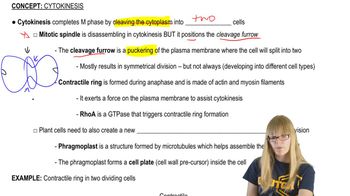
 04:03
04:03