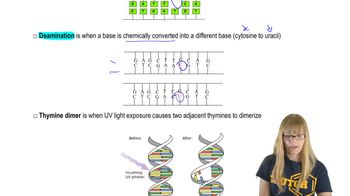
Which part of a cell is primarily damaged by ultraviolet (UV) radiation?
UV radiation primarily damages the DNA in a cell by causing the formation of thymine dimers, which distort the DNA double helix.
What type of DNA damage is caused by exposure to UV light in cells?
Exposure to UV light causes the formation of thymine dimers in DNA, where two adjacent thymine bases become covalently bonded, leading to distortion of the DNA structure.
What is depurination in the context of DNA damage?
Depurination is the spontaneous loss of purine bases, such as adenine and guanine, from DNA. This results in missing nucleotides and can disrupt the DNA sequence.
Which enzyme is responsible for recognizing and removing chemically damaged bases during base excision repair?
DNA glycosylase is the enzyme that recognizes and excises chemically damaged bases. It removes the incorrect nucleotide, allowing for its replacement with the correct one.
What type of DNA repair mechanism is primarily used to fix bulky lesions like thymine dimers?
Nucleotide excision repair is used to fix bulky lesions such as thymine dimers. It removes a large segment of nucleotides and replaces them before DNA ligase reseals the strand.
What is the role of RecA proteins during homologous recombination?
RecA proteins stabilize single-stranded regions of broken and undamaged DNA during homologous recombination. This prevents degradation and facilitates strand invasion.
What is strand invasion in homologous recombination?
Strand invasion is when the single-stranded region of the broken chromosome invades the homologous chromosome to find its complementary sequence. This step is crucial for accurate DNA repair using the undamaged template.
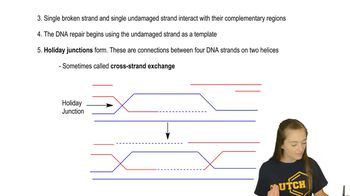
What are Holiday Junctions and why are they important in homologous recombination?
Holiday Junctions are X-shaped structures formed where two DNA molecules cross during homologous recombination. They are essential for the exchange and repair of genetic material between homologous chromosomes.
What is branch migration in the process of homologous recombination?
Branch migration is the movement of the Holiday Junction as new DNA is synthesized during repair. It allows the extension of the repaired region along the damaged DNA strand.
How does the resolution of Holiday Junctions differ from dissolution in homologous recombination?
Resolution involves cutting the Holiday Junctions, often resulting in crossover and exchange of genetic material beyond the damaged area. Dissolution unwinds the junctions without crossover, only repairing the break.
 Back
Back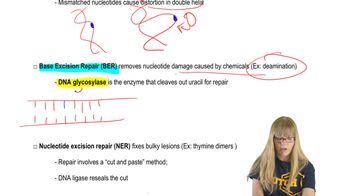
 03:52
03:52